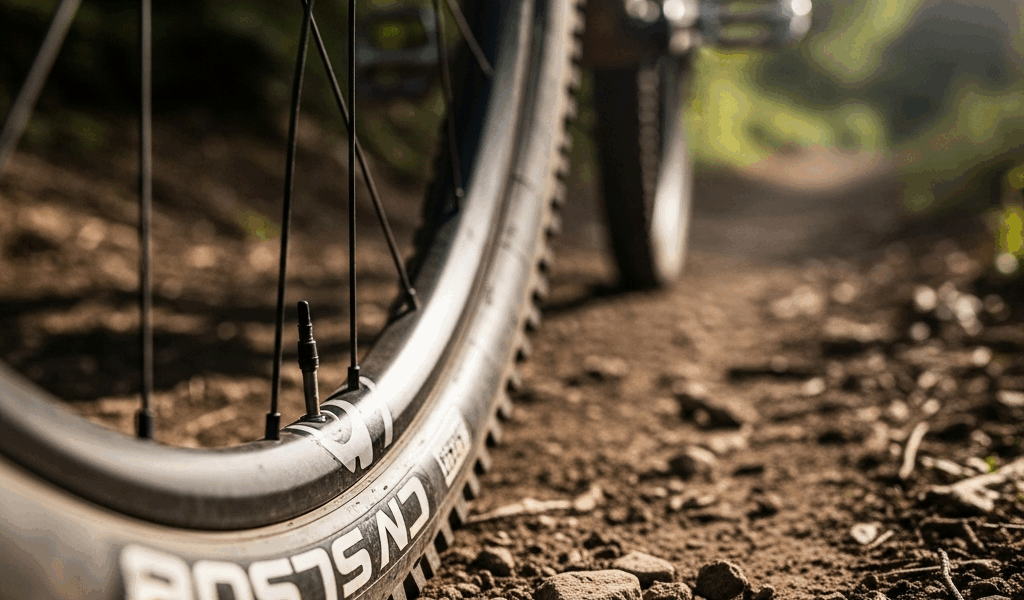
MTB tire selection has gotten more complicated than it needs to be — three compound designations, six casing options, and tire widths that span an inch of range with genuine performance implications at each step. As someone who has ridden everything from cheap OEM tires to high-end race rubber across multiple terrain types and seasons, I’ve learned that the selection actually simplifies to three variables once you understand what each one does. Here’s all of it.
Tread Patterns — Matching Knobs to Conditions
Tread pattern determines how your tire bites into the surface under you. The key variables are knob height, knob spacing, and knob shape.
Low-profile, tight-spaced knobs (XC/hardpack tires like the Maxxis Aspen or Specialized Renegade) roll fast on firm, dry trails because there’s more rubber contact and less drag. The tradeoff is they wash out quickly in mud or loose terrain — the gaps between knobs fill with debris and the tire loses bite. Riding hardpack tires on wet loam is one of the more confidence-destroying experiences available to mountain bikers.
Tall, widely-spaced knobs (enduro and trail tires like the Maxxis Minion DHF, Schwalbe Magic Mary, or Specialized Butcher) dig into soft soil, shed mud, and grip loose-over-hard terrain. They’re slower rolling but vastly more confidence-inspiring when the trail surface gets unpredictable.
Side knobs matter as much as center knobs for cornering. Look for tall, ramped side lugs with a defined shoulder — these are what engage when you lean into a turn. Tires with rounded profiles and minimal side knobs feel vague in corners even if they’re acceptable on straight terrain. That’s what makes side knob design so important to us trail riders — it’s the variable that determines whether the bike feels planted or nervous in the turns you’re actually trying to push.
For most trail riders in mixed conditions, a semi-aggressive front tire paired with a faster-rolling rear is the standard setup. Your front tire handles steering traction and braking grip; your rear handles pedaling traction and is where rolling resistance matters most.
Width — Bigger Isn’t Always Better
MTB tire widths typically run from 2.1″ (XC race) to 2.6″ (enduro) with 2.4–2.5″ being the most versatile range for most riders.
Wider tires provide a larger contact patch, meaning better grip and the ability to run lower pressures without pinch flatting. At 18–22 psi on a 2.4″ tire, you get a compliant, grippy ride that absorbs trail chatter better than a rigid 2.2″ tire at 30 psi ever could. The difference in rough terrain grip between correctly pressured wide tires and narrow tires is significant and immediate.
The tradeoff is weight and frame clearance. A 2.6″ tire might not clear your chainstays. A 2.35″ tire spun up on a climb feels noticeably lighter than a 2.5″. On hardpack and smooth trail, wider tires offer diminishing returns in grip while adding drag and weight.
The sweet spot for most trail and enduro riders is 2.4–2.5″ front, 2.3–2.4″ rear. XC and cross-country race setups go narrower (2.1–2.25″) to prioritize rolling speed. I’m apparently someone who has tried to run 2.6″ tires on a frame that wasn’t designed for them — a chainstay rub on every pedal stroke is an effective lesson in checking clearance specs before buying.
Rubber Compounds — Hard vs. Soft and Why It Matters
Compound (measured in Shore A hardness) determines how sticky the rubber is. Softer compounds grip better because the rubber deforms around surface irregularities. Harder compounds roll faster and last longer.
Most quality MTB tires now offer dual or triple compounds — harder rubber in the center tread for rolling efficiency, softer rubber on the side knobs for cornering grip. This is a genuine engineering win: you get most of the rolling speed of a hard tire with the cornering grip of a soft one.
Common compound designations:
- Maxxis MaxxTerra / 3C MaxxTerra — medium center, soft sides. Best all-around for trail and enduro
- Maxxis MaxxSpeed — harder overall for XC race use, low rolling resistance
- Schwalbe Soft Compound / Super Soft — aggressive grip, best for wet conditions
- Specialized GRIPTON — tiered compound system (T5, T7, T9 — higher number = stickier)
For most riders, MaxxTerra or equivalent dual-compound front and rear is the right call. Save the soft compound for wet season or race day — it wears significantly faster on abrasive surfaces.
Casing — The Underrated Variable
Tire casing is the structural layer under the rubber. It determines puncture resistance, sidewall stiffness, and weight. Lightweight casings (Maxxis EXO, Schwalbe Trail Star) are designed for tubeless setups and offer reasonable protection without significant weight penalty. Fine for most trail riding.
Reinforced casings (Maxxis EXO+, DoubleDown, Schwalbe Super Trail) add a secondary protective layer for rocky, aggressive terrain. Heavier, but dramatically reduces sidewall cuts and pinch flats on sharp-edged rock gardens and exposed roots. If you’re riding tubeless on rocky, exposed terrain, the extra 80–100 grams of a reinforced casing is worth every gram. A single saved flat on a long trail day more than justifies the weight.
Quick Selection Guide by Riding Style
- XC / Race: Maxxis Aspen or Ikon front/rear, 2.2–2.35″, MaxxSpeed compound, EXO casing
- Trail / All-Mountain: Minion DHF front / Aggressor or DHR II rear, 2.4–2.5″, MaxxTerra, EXO or EXO+
- Enduro / DH: Minion DHF front / DHR II rear, 2.4–2.5″, MaxxTerra or MaxxGrip, DoubleDown casing
- Wet / Muddy: Schwalbe Magic Mary or Maxxis Shorty front, MaxxGrip or Super Soft compound
Tires wear differently front and rear. Most riders burn through a rear tire 2–3x faster than the front. Rotate or replace the rear more frequently and keep the front in better condition — a worn front tire is where loss of traction and crashes originate.



Stay in the loop
Get the latest trail rise updates delivered to your inbox.