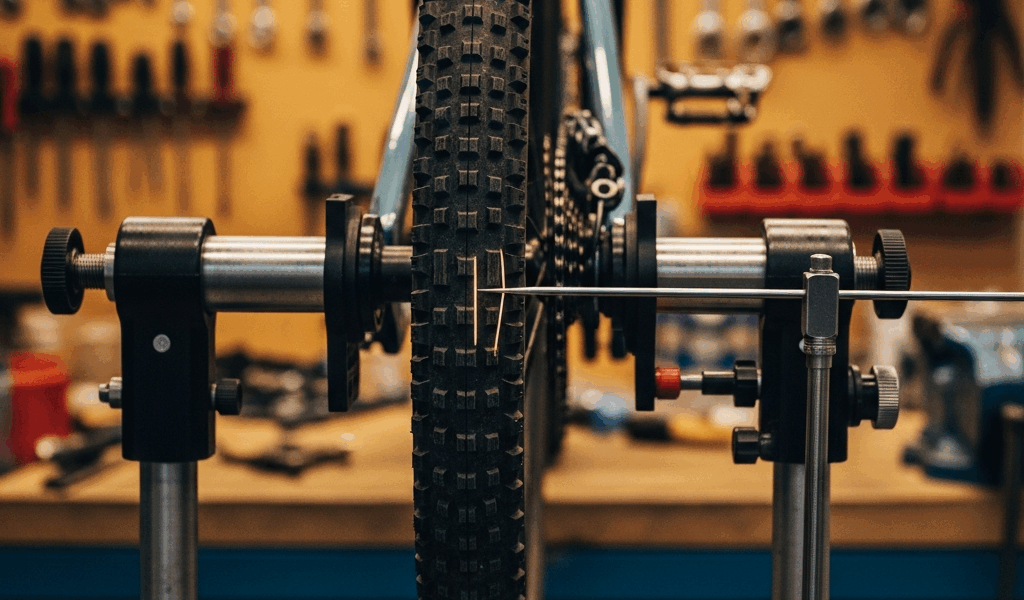
Why Your Wheel Keeps Going Out of True
Wheel truing has gotten complicated with all the conflicting advice flying around. As someone who spent two full seasons chasing true on my hardtail’s rear wheel before finally understanding what was actually happening, I learned everything there is to know about why wheels detune themselves. Today, I will share it all with you.
You’ve probably already fought this problem twice — maybe three times since spring. The frustrating part isn’t the first time you fix it. It’s that the wheel goes wobbly again within a few weeks of normal riding, sometimes less. Most articles show you how to use a spoke wrench and call it done. They skip the part that actually matters: why the wheel loses true in the first place.
Probably should have opened with this section, honestly. There are three specific reasons a wheel won’t hold true, and they’re not equally common. Knowing which one applies to your situation changes everything.
First: inconsistent spoke tension. Spokes don’t work as individuals — they function as a system under load. When some spokes carry 80 pounds of tension and their neighbors carry 120, stress redistributes every time you ride. The wheel settles into a new shape that looks fine for maybe 50 miles. Then it shifts again.
Second: nipples loosening from stress cycles. Every rock garden, every root hit, every three-foot drop sends a shockwave through the rim. The nipples — those small brass pieces at the rim bed where the spoke adjusts — work loose by fractions of a turn. After 20 rides, they’ve collectively backed off enough that lateral true vanishes. Not so much that you notice by eye. You spin the wheel, spot the runout, grab a Park Tool SW-0 or whatever’s in your bag, and repeat the whole cycle.
Third: actual structural damage. A cracked eyelet near a spoke hole. A hairline fracture in the rim bed. A loose hub flange. None of these can be trued away. I spent an embarrassing number of evenings in my garage chasing ghosts before I learned to inspect first. Don’t make my mistake.
How to Check If Your Spokes Are Evenly Tensioned
Before you touch a spoke wrench, you need to know whether your spokes are actually balanced. But what is spoke tension balance? In essence, it’s the even distribution of load across every spoke in the wheel. But it’s much more than that — it’s the difference between a wheel that holds true for a season and one that needs attention every few weeks.
While you won’t need a $300 tensiometer, you will need a handful of minutes and two simple methods: the ping test and the squeeze test.
The ping test is exactly what it sounds like. Tap a drive-side spoke gently with a spoke wrench or small mallet. Listen. Now tap a non-drive-side spoke. Both should produce a clear, sharp ring at nearly the same pitch. High pitch on one side, low on the other — that’s a tension imbalance. It happens constantly on rear wheels because drive-side spokes pull harder to support the cassette, and most truing jobs never address it.
The squeeze test tells you where the problems live. Grab two parallel spokes — one on either side of the rim — and squeeze them firmly together. They should feel springy and flex a little coming back. Barely any flex means that area is over-tensioned. Compresses too easily with almost no resistance? Under-tensioned. Work your way around the entire wheel every 45 degrees or so. You’ll start to feel a pattern emerge — maybe the drive side is dramatically tighter, or maybe one quadrant of the wheel feels noticeably softer than the rest.
That’s what makes this diagnostic step so useful to us home mechanics. A typical truing session focuses only on lateral runout — spinning the wheel, finding where it hits the brake pad, turning spokes. The wheel looks true afterward. It stays true for 40 miles. Then, under load and vibration, the spokes settle toward their preferred tension, and the wheel shifts again. You never addressed the root cause.
Stress Relieving Your Spokes After Truing
Stress relieving is the step almost nobody does. It’s boring. It takes 15 minutes. It shows no immediate satisfying results. It is also — and I cannot stress this enough — the reason your wheel won’t stay true.
After truing, the spoke nipples, rim, and spoke heads are all sitting at artificial tension points. They haven’t settled yet. The moment you ride, every vibration nudges them slightly. Over the next few rides, they relax toward lower tension. The wheel goes out of true — not because you trued incorrectly, but because the spokes hadn’t finished moving.
So, without further ado, let’s dive in. Here’s exactly how to do it:
- After truing, grab two parallel spokes — one on the left of the rim, one on the right, roughly opposite each other — and squeeze them together firmly for 2 to 3 seconds
- Work your way around the entire wheel in overlapping pairs, completing two full passes
- Spin the wheel after each pass and check for runout — it will temporarily get worse before it gets better, and that’s fine
- Do a third pass focusing on the areas that showed the most movement
- Re-check lateral true in the stand and correct what’s moved
- Repeat the entire process one more time the following day
What you’re doing is pre-settling the spokes. Tension points shift under controlled, predictable pressure instead of random trail impacts. The wheel will settle less aggressively under actual load because it’s already mostly settled. I’m apparently someone who skipped this step for two full seasons, and a Park Tool TS-2 truing stand sat in my shop doing half a job while I wondered why nothing held. The squeeze method works for me while skipping it never did.
Yes, your true might get slightly worse mid-process. The spokes are moving — that’s the point. You’ll true it back out, and this time it’ll hold because the nipples have already found their resting position.
When the Real Problem Is Your Rim or Hub Flange
Not every wheel that won’t stay true needs better technique. Some wheels can’t stay true because they’re damaged. But what is a cracked eyelet, exactly? In essence, it’s a structural failure at the reinforced metal ring where the spoke hole lives in the rim. But it’s much more than that — it’s a guarantee that no amount of spoke adjustment will fix your problem.
High-impact landings and hard crashes crack eyelets. Once cracked, spoke tension distributes unevenly around that area. You true the wheel, load pulls differently through the crack, and true vanishes within a few rides. That’s it. That’s the whole story. You cannot spoke-wrench your way out of this.
Hairline rim cracks near spoke holes work the same way. They’re often nearly invisible — clean the rim thoroughly first, then shine a flashlight at a low angle across the rim bed. Any crack radiating outward from a spoke hole means that rim is compromised. I’d replace it rather than rebuild onto it.
Loose hub flanges are less common but still happen — especially on older bikes or anything that’s been crashed hard. The flange is the part of the hub where spokes attach. A shifted or loose flange creates uneven spoke seating — spokes don’t sit at consistent depth, tension becomes unreliable, and the wheel won’t hold. Grab the hub and try to wiggle the flange side-to-side. Zero play. That’s the standard. Anything else is a problem.
First, you should stop truing and start inspecting — at least if you’ve already trued the wheel twice in the past six weeks under normal riding. A visual inspection takes 10 minutes. If you find cracks or flange movement, the wheel needs rebuilding or the rim needs replacing. That might be the best option here, as structural damage requires structural repair. That is because no spoke adjustment addresses the underlying failure — it just masks it temporarily.
How to Keep Your Wheel True Between Rides
Once you’ve fixed the actual underlying issue, ongoing maintenance is straightforward. Genuinely.
Check spoke tension every three months using the ping test. Ninety seconds per wheel. If the drive side is pinging noticeably higher than the non-drive side, do a light re-tension pass on the non-drive spokes — a quarter turn each, all the way around, nothing dramatic.
After any significant impact — hard crash, heavy landing, a rock garden that rattled your fillings — do a single stress-relief pass. One full cycle around the wheel using the squeeze method. This prevents the impact from creating new tension imbalances that compound over your next several rides.
Keep nipples from corroding. One drop of light machine oil — Phil Wood Tenacious Oil works well, though any light machine oil does the job — at each spoke hole where the nipple meets the rim bed. Corrosion locks nipples in place, makes them harder to adjust, and makes them more prone to cracking under tension. One drop per nipple, every fall. The whole wheel takes maybe 10 minutes. It prevents months of frustration down the road.
The real signal that something upstream is wrong: truing more than twice in a single season under normal riding conditions. The wheel was never stress-relieved properly, the rim is beginning to crack, or the spokes were never balanced to begin with. Stop chasing true endlessly — diagnose the root cause once, fix it completely, and your wheel will hold for years.



Stay in the loop
Get the latest trail rise updates delivered to your inbox.