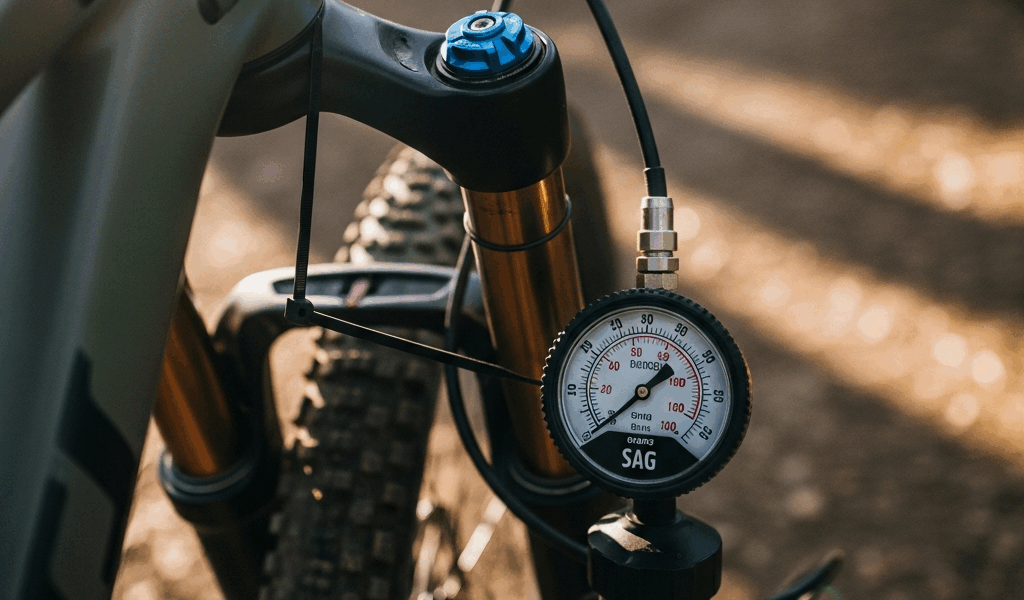
Suspension setup has gotten a reputation for being complicated — shock pumps, rebound dials, compression clicks, volume spacers. As someone who rode with terrible suspension setup for years before finally dialing it in properly, I can tell you the whole process is actually about 20 minutes and a shock pump once you understand what you’re adjusting and why. The gains are real and immediate. Here’s how to do it.
Setting Sag — Start Here
Sag is how far your suspension compresses under your weight alone, before you start moving. It ensures the suspension can extend (rebound) over drops and holes as well as compress over bumps. Without proper sag, your bike either sits too high — skimming over the trail surface with a harsh ride — or wallows too low, with poor pedaling efficiency and a tendency to bottom out.
How to measure sag: with the bike on the ground unloaded, slide the o-ring on the fork stanchion or rear shock shaft to the wiper seal. Mount the bike in full riding position — feet on pedals, hands on bars, body weight centered. Lift off and measure how far the o-ring moved from the seal. That distance divided by total travel gives your sag percentage.
Target sag values:
- XC / race hardtail: 15–20%
- Trail full-suspension: 25–30%
- Enduro: 28–32%
- Downhill: 30–35%
Adjust air pressure using a shock pump to hit the target. Add air to reduce sag, release to increase it. Make adjustments in 5–10 psi increments — they move sag meaningfully.
Rebound — Controlling the Return Speed
Rebound controls how fast the suspension returns to full extension after compressing. Get this wrong and the bike becomes genuinely unpleasant — or dangerous.
Too slow (too much rebound damping): Suspension can’t fully extend between hits. Over a series of bumps, it “packs down” and you’re effectively riding without suspension. The bike feels harsh and unresponsive.
Too fast (too little rebound damping): The suspension fires back violently after each hit. The front end bucks up and deflects off obstacles. In a corner, a fast rebound rear can kick you off line.
The rebound test: compress the fork hard and let go. Watch how the wheel returns. You want it to return fully in one smooth motion — not bounce (too fast) and not creep slowly back (too slow). Start with all rebound turned in (slow), then back it out until the wheel returns cleanly without bouncing. Rebound and sag are linked — more sag means more spring force, which means faster rebound tendency. Re-check rebound after setting sag.
Compression — HSC and LSC
Higher-end forks and shocks have separate high-speed compression (HSC) and low-speed compression (LSC) damping. Many trail bikes have only one compression adjuster — typically LSC.
Low-speed compression (LSC) controls damping during slow, sustained inputs — brake dive, rider body movement, pedaling bob. Increasing LSC firms up the platform feeling. Too much LSC and the fork feels wooden and doesn’t absorb trail chatter. Starting point: 3–5 clicks from fully closed.
High-speed compression (HSC) controls response to fast, sharp impacts — square-edged hits, rock gardens, drops. HSC is generally best left near the baseline unless you’re consistently bottoming out on high-speed hits despite correct air pressure.
Handling Bottoming Out
Occasional bottoming out is normal and expected on full-travel bikes — it means you’re using all available travel. Frequent, harsh bottoming out signals a setup problem. First, add 5–10 psi. If that doesn’t resolve it, check whether your fork or shock supports a volume spacer — a small insert that progressively ramps up the air spring toward end of travel. Most modern forks allow 1–3 spacers. Adding one reduces harsh bottom-out without changing the feel through mid-stroke. I’m apparently someone who needed two spacers on my enduro fork before it stopped bottoming on big hits — the first one made a noticeable difference, the second made it right.
Fork vs. Rear Shock — They Work Together
A common mistake is tuning fork and rear shock independently without considering balance. The rear of the bike should feel slightly more supportive than the front on descents — this keeps your weight forward and the front wheel tracking. Set your rear sag 2–3% lower than front as a starting point. Run slightly slower rebound on the rear (1–2 more clicks of damping) than the front. This creates a nose-down bias that improves front wheel tracking and confidence on technical descents.
When to Service Your Suspension
Lower leg service (fork): every 50–100 hours of riding. Full rebuild: every 200 hours. Signs it’s overdue: oil on the stanchions, stiff or notchy movement, reduced small-bump sensitivity even after air adjustments. Fresh suspension oil changes the ride quality dramatically — more than most riders expect the first time they do it.




Stay in the loop
Get the latest trail rise updates delivered to your inbox.