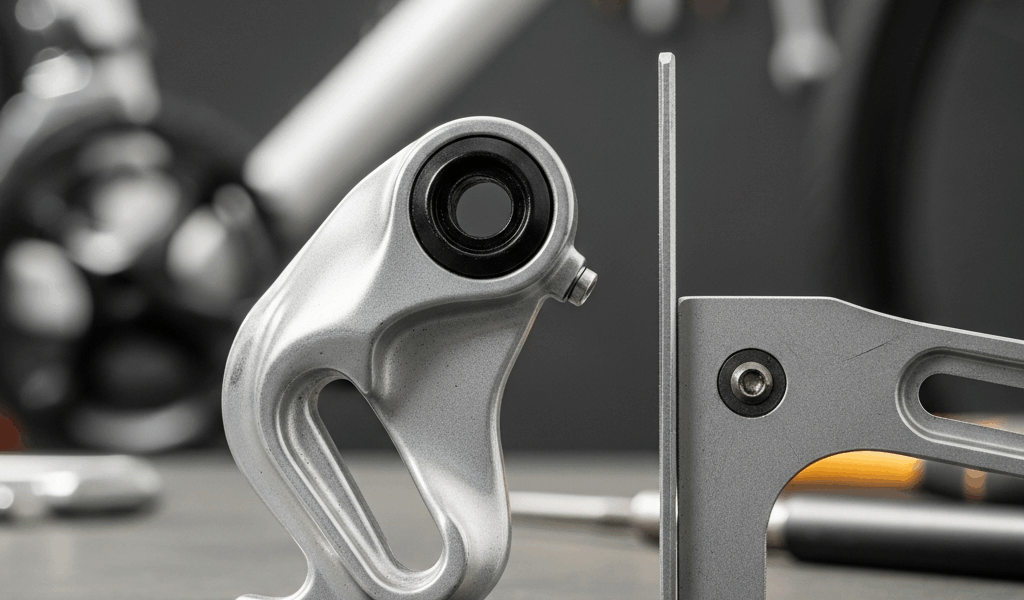
How to Tell If Your Derailleur Hanger Is Actually Bent
Derailleur troubleshooting has gotten complicated with all the conflicting advice flying around. As someone who has bent my hanger twice — once the hard way, once the fast way — I learned everything there is to know about diagnosing this specific problem. Today, I will share it all with you.
The first time it happened, I burned forty minutes adjusting limit screws and re-running cable tension. Forty minutes. The hanger was the problem from minute one. Second time around, I spotted it in about five seconds flat. That gap in diagnostic speed is exactly what this guide closes.
A bent MTB derailleur hanger announces itself through three symptoms. Your chain skips under load — even after you just cleaned and lubed everything. The derailleur cage sits at a visibly weird angle relative to the cassette. Or shifting that worked perfectly on Tuesday now struggles across every single gear by Thursday. One of those, maybe it’s something else. All three together? It’s the hanger.
Here’s the fast eyeball check. Stand directly behind the bike. Look straight down at the derailleur from above the cassette. The cage should run parallel to the cogs — clean and even. If it’s tilting inward or kicking outward, the hanger is bent. That’s the whole diagnosis. You’re done.
But separate this from the other usual suspects. A limit screw set too tight will block the chain from reaching the smallest or largest cog — only at that extreme end, nowhere else. Cable tension that’s drifted off causes gradual misalignment across the range, but the cage itself stays perpendicular to the cogs. A bent hanger breaks the whole system at once. Every gear. Every shift. That total breakdown is your real signal.
Still not sure? Grab the derailleur cage and try moving it side to side with your hand. A healthy hanger doesn’t move. A bent one has lateral play you can actually feel — a subtle shift against the bracket that shouldn’t be there. That movement is your confirmation.
Should You Straighten It or Replace It Right Now
Probably should have opened with this section, honestly. Most guides skip straight to the how-to and leave riders either stranded on the trail or replacing parts they didn’t need to touch.
So, without further ado, let’s dive in — here’s the decision tree that actually matters:
- Is the hanger cracked or creased? Replace it immediately. Aluminum hangers crack after being bent back once or twice. That’s not a home repair.
- Does the metal look splintered or show a permanent crease? Replace it. Same reason, no exceptions.
- Has this specific hanger been bent before? Replace it. The metal is already structurally compromised.
- Is this a first-time mild bend and you’re currently mid-ride with no spare? Straightening works as a temporary get-home fix. Nothing more than that.
- Do you have a derailleur alignment tool and about thirty minutes? You can attempt a proper straightening at home — at least if the hanger passes all the tests above.
Steel hangers exist on some older bikes and budget models. They forgive repeated bending better than aluminum does. But aluminum — which is almost certainly what you’re working with — doesn’t forgive repeated stress cycles. One bend, straightened correctly, is fine. Two bends and you’re genuinely gambling with a $200 derailleur.
The cost math is straightforward. Most derailleur hangers run $8 to $18 depending on the model. That’s less than a beer at the trailhead. The derailleur doing the actual shifting work costs $80 to $300. Replacing a $12 hanger instead of risking the whole drivetrain is the only math that makes sense here.
How to Straighten a Bent Hanger With an Alignment Tool
A derailleur alignment gauge — sometimes called a DAG tool — is the only way to do this properly at home. I’m apparently a Park Tool loyalist and the DAG-2.2 works for me while generic alternatives never quite deliver the same consistency. It runs about $40 and handles most dropout types. Don’t make my mistake of trying to eyeball it freehand the first time.
Start by pulling the rear wheel. You need clear access to the hanger from behind.
Thread the alignment tool into the hanger’s mounting threads — the same hole where your derailleur bolts in. Hand-tight once it’s seated. Rotate the measuring arm straight down to the 6 o’clock position. That’s your baseline.
Now check the gap between the measuring arm and the rim. Write down that number. Rotate around the clock to 12, 3, and 9 o’clock — recording each gap measurement. The differences between positions show you exactly where the bend lives and how bad it actually is.
Here’s where patience matters more than strength. Apply gentle lateral pressure to the hanger — opposite the direction of the bend — using your hand. Not a hard shove. Gentle, gradual correction. Apply pressure, rotate to 6 o’clock, measure, repeat. Small bends typically take two or three full passes around the clock before they’re dialed.
Feel for resistance. If the metal is fighting back hard or feels like it’s about to crease, stop immediately. That’s the limit of what straightening can do — past that point, you’re creating a failure zone. Replace the hanger instead.
Once all positions measure consistently within 0.5mm, you’re done. Thread out the tool, reinstall the wheel, and test on a short flat ride before heading back to the trails proper.
Emergency Field Fix Without Any Tools
You’re ten miles into a ride. You hit a rock garden. The hanger bent. No spare, no alignment tool, no shop for miles. This section is for you.
Shift into an easier gear first — somewhere in the middle of the cassette where chain tension stays lowest. That reduces the load while you work.
Stand behind the bike. Look down at the derailleur cage and watch its alignment against the cogs. Using your hand, apply slow sideways pressure to the cage bracket — not the derailleur body itself, but the metal bracket the derailleur bolts onto. That’s your hanger. Apply pressure, watch the cage shift, feel the metal flex slightly, hold it there a moment, release. Repeat until it looks close.
After each pass, run through the gears slowly. Does it feel better? Is the chain tracking? You’re not tuning here. You’re testing. Good enough to get home is the only goal.
Ride easy after this — no hard sprints, no grinding climbs that load the derailleur heavily. Keep cadence smooth and relaxed. Yes, you’ll probably move the hanger slightly more by riding out. That’s acceptable. It’s a temporary measure, full stop.
Replace the hanger the same day you get home. Don’t ride it normally after a field fix.
Why You Should Always Carry a Spare Hanger
But what is a spare hanger strategy? In essence, it’s spending $12 and 10 grams of pack weight to guarantee you never get stranded mid-ride again. But it’s much more than that — it’s the habit that separates riders who finish every ride from riders who don’t.
Hangers are bike-specific. Your Trek hanger won’t fit your buddy’s Specialized. Know your model number before you buy — snap a photo of your dropout or pull the spec sheet from the manufacturer’s website. One spare per bike is the baseline. Two spares if you ride rocks or technical terrain regularly.
That’s what makes carrying a spare hanger endearing to us trail riders. It weighs nothing, costs nothing relative to the alternative, and a trailside swap takes five minutes. Faster than any straightening process. Guaranteed shifting for the rest of the day.
Keep one in the saddle bag, one at home. When one bends — and eventually one will — replace it on the trail, bring the bent one back, straighten it with the alignment tool, and rotate it into backup duty. That cycle keeps you riding without interruption.
Get out there and ride hard. The trail won’t wait, and neither will your derailleur.




Stay in the loop
Get the latest trail rise updates delivered to your inbox.