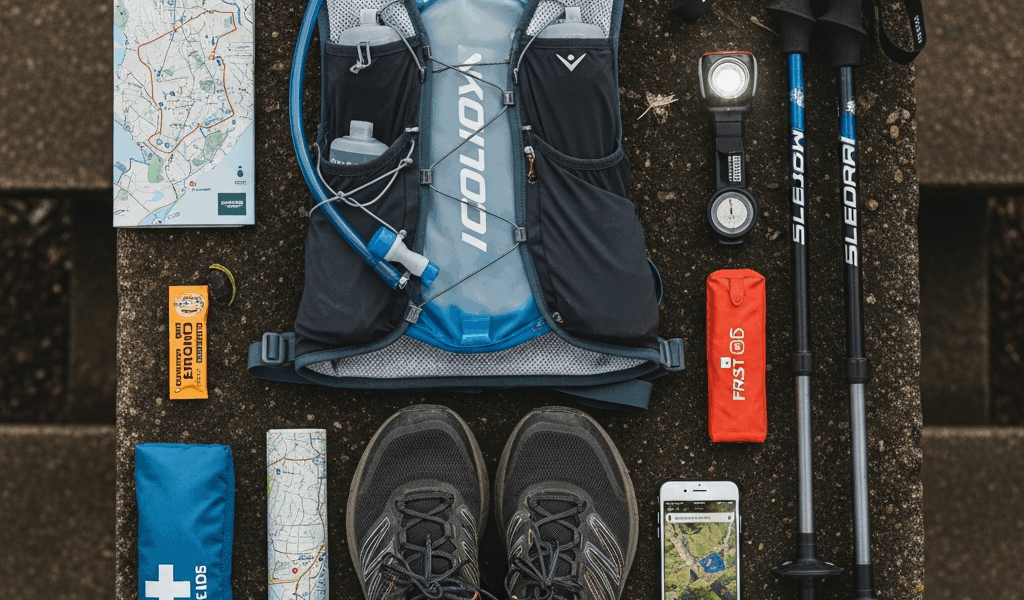
Trail running gear has gotten expensive and the marketing has gotten good enough to make everything feel essential. As someone who has bought most of it — some of which was genuinely useful, some of which still sits in a drawer — I’ve learned that the list of gear that actually makes a difference is much shorter than the industry wants you to believe. Here’s what’s worth spending on and what to skip until you know you need it.
Trail Running Shoes — The Highest-Impact Purchase
Your shoes are the only gear that actually touches the trail. Getting this right matters more than any other purchase. The key variables:
Lug depth and pattern: Tightly-spaced, shallow lugs (3–4mm) roll fast on firm, dry trails but lose traction in mud. Deep, widely-spaced lugs (5–6mm) grip in wet and loose conditions but are slower and heavier on hardpack. Most trail runners end up needing one shoe for firm conditions and a mud shoe for wet season — not because the gear industry tells them to, but because no single shoe genuinely does both well.
Stack height: More cushion (30–35mm) is appropriate for long ultras where impact protection on fatigued legs matters. Less cushion (18–25mm) gives better ground feel and proprioception on technical terrain. Most runners are served by something in the middle (25–30mm) as an all-around choice. I’m apparently someone with joints that prefer the more cushioned end of that range, which I discovered gradually and expensively.
Fit: Trail shoes should fit snugly in the heel and midfoot to prevent slippage on descents, with enough toe box width that your toes aren’t compressed. Go half a size up from your road shoe size — feet swell on long runs and on descents, feet slide forward into the toe box.
Standout options: Hoka Speedgoat 6 (all-day cushion, versatile terrain), Salomon Speedcross 6 (excellent in wet and mud), Altra Lone Peak 8 (wide toe box, zero drop), La Sportiva Bushido III (aggressive terrain, precise fit).
Running Vest — Essential for Anything Over 60 Minutes
A running vest replaces a hydration belt and a hand-held bottle with something that carries more, distributes weight better, and keeps your hands free. For trail running, this is the upgrade that changes how you run more than any other piece of gear — which I did not believe until I tried one and never went back.
What to look for: front soft flasks (not a single rear reservoir — front-loading keeps weight stable and accessible), a fit that doesn’t bounce on descents, enough front pocket storage for your most-used items, and a back compartment large enough for a jacket layer and mandatory race gear. The Salomon ADV Skin series fits the widest range of body types well. Nathan Pinnacle and Ultimate Direction FastPack are excellent alternatives. Plan to spend $120–$200 for a quality vest — it’s a long-term purchase that holds up for years.
Poles — Underused by Recreational Runners
Trekking poles on ultras and mountain runs reduce leg fatigue significantly on extended climbing by distributing effort to the upper body. They also provide stability on technical descents and creek crossings. Many recreational trail runners skip them because they look effortful to carry — collapsible carbon poles (Black Diamond Distance Carbon FLZ, Leki Micro Stick Carbon) weigh 150–200 grams per pair and strap to most vests instantly.
That’s what makes poles endearing to experienced ultra runners — once you’ve used them correctly on a long mountain run, you understand why virtually every professional trail ultra runner uses them. Learning the basic technique takes a few runs of deliberate practice. Plant the pole opposite to your leading foot, use a short efficient push, don’t lean on them for support.
Headlamp — Non-Negotiable for Early Starts
For pre-dawn starts, post-sunset finishes, or any run in remote terrain, a quality headlamp is safety equipment, not a nice-to-have. The minimum: 300+ lumens, a red light mode for preserving night vision when checking maps, and enough battery life for your longest anticipated run.
The Black Diamond Spot 400 ($40) covers most trail runners’ needs. The Petzl Swift RL ($80) adds reactive lighting that adjusts to trail conditions automatically. The Nitecore NU25 ($35) is ultra-light (85g) and charges via USB — no battery management required. Any of these is the right choice; no headlamp is not.
What You Don’t Need Yet
GPS watch, carbon fiber poles, full-length trail gaiters, PLB — all of these have appropriate use cases, but none of them belong on your initial gear list if you’re running accessible local trails. Buy the shoes first. Get a vest when runs exceed 60 minutes regularly. Add everything else based on the specific terrain and distances you’re actually running, not because the gear store suggests you might need it someday.


Stay in the loop
Get the latest trail rise updates delivered to your inbox.