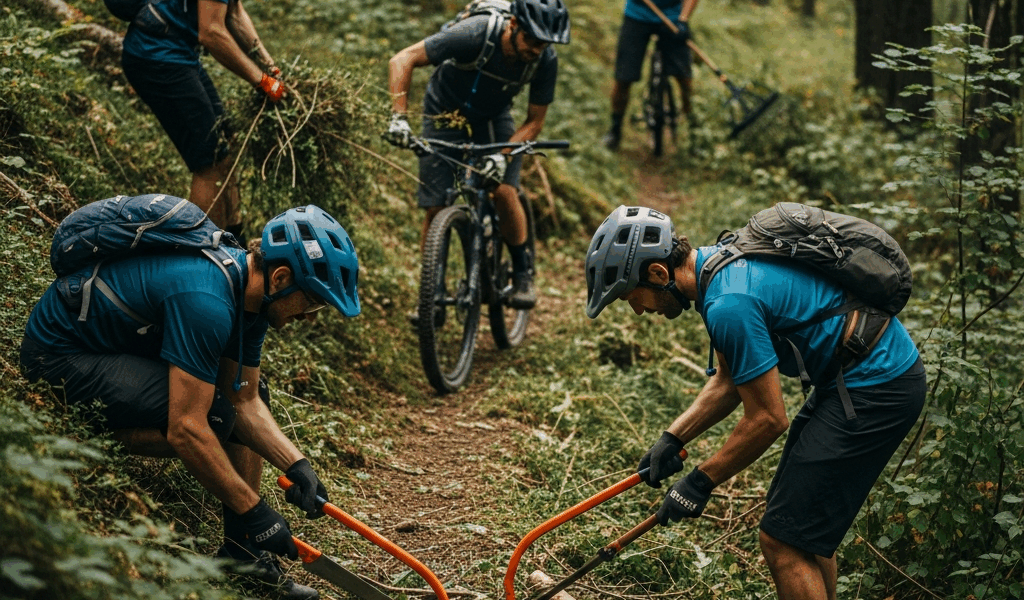
Trail maintenance has gotten a lot of attention lately as trail use has exploded, but a lot of riders still treat it as somebody else’s problem. As someone who’s shown up to trail days and watched the same ten people do the work for hundreds of regular riders, I’ve learned that it doesn’t take much to be part of the solution rather than part of the erosion problem. Here’s how to actually contribute in ways that matter.
Join Your Local Trail Advocacy Organization
The International Mountain Bicycling Association (IMBA) coordinates trail advocacy at the national level, but the practical work happens through local chapters and affiliated clubs. Most areas with meaningful trail networks have an active trail organization — the Evergreen Mountain Bike Alliance in Washington, the Bicycle Coalition of Maine, the Sustainable Trails Coalition, and hundreds of others spread across the country.
Membership dues fund both advocacy work and on-the-ground maintenance. Even if you never make it to a single trail day, paying dues to your local trail org is the baseline contribution. $25–$50 a year funds tools, materials, and the staffing that makes organized trail work possible. That’s less than most people spend on a single lunch. There’s no good reason not to do it.
Trail Days — What to Expect and How to Show Up
Trail maintenance days get announced through club websites, Meetup groups, and social media. Most require zero prior experience — the work involves removing deadfall, clearing brush, draining water bars, fixing berms, and moving rock. Skilled leaders direct the work and there’s always something useful for first-timers to do.
What to bring: sturdy boots (not trail running shoes — I made that mistake once), gloves, a full water bottle, layers for whatever the weather is doing, and a willing attitude. Clubs typically provide tools and some provide lunch. Show up on time, follow directions from the lead trail builder, and don’t modify trail features independently unless you’re experienced and it’s been specifically authorized. Well-intentioned but uncoordinated trail work creates more problems than it solves more often than you’d think.
Adopt-a-Trail Programs
Many land managers run adopt-a-trail programs where groups or individuals take responsibility for monitoring and basic maintenance on a specific trail segment. It’s typically a 2–3 times per year commitment — clear drains, remove small deadfall, report larger issues to the managing agency. Lower time commitment than regular trail days, and it creates a direct accountability relationship between riders and the land they actually ride on. That’s what makes adopt-a-trail programs so valuable to the community — the maintenance is done by people who know and care about that specific trail.
Reporting Trail Issues
Most land management agencies and trail clubs want to know about significant damage, downed trees blocking trail, erosion that’s getting worse, and infrastructure problems. Many have apps or web forms for trail condition reports now. Using those systems — rather than just posting about it on Instagram — actually gets the issue into a maintenance queue that someone acts on.
Photos with trail name and approximate location are most useful. Don’t try to fix structural problems yourself unless you’re trained. A poorly-executed repair can make drainage problems worse or damage the trail’s intended design in ways that are more expensive to fix than the original problem.
Skill Development for Trail Building
If you want to do more than basic maintenance, trail building courses from IMBA and local organizations develop the skills to design sustainable trails, build effective drainage features, and shape berms and technical features correctly. Sustainable trail design is a skilled craft — the difference between a trail that’s still in good shape 20 years later and one that’s a muddy disaster by its second season is entirely the quality of the construction.
Trail building skills also make you a better rider, which probably isn’t why you’d sign up for a course but ends up being a real side effect. Understanding how a berm is built and why a particular entry speed works for it changes how you read features on trail. The relationship between builder and rider becomes direct when you’re both.

Stay in the loop
Get the latest trail rise updates delivered to your inbox.