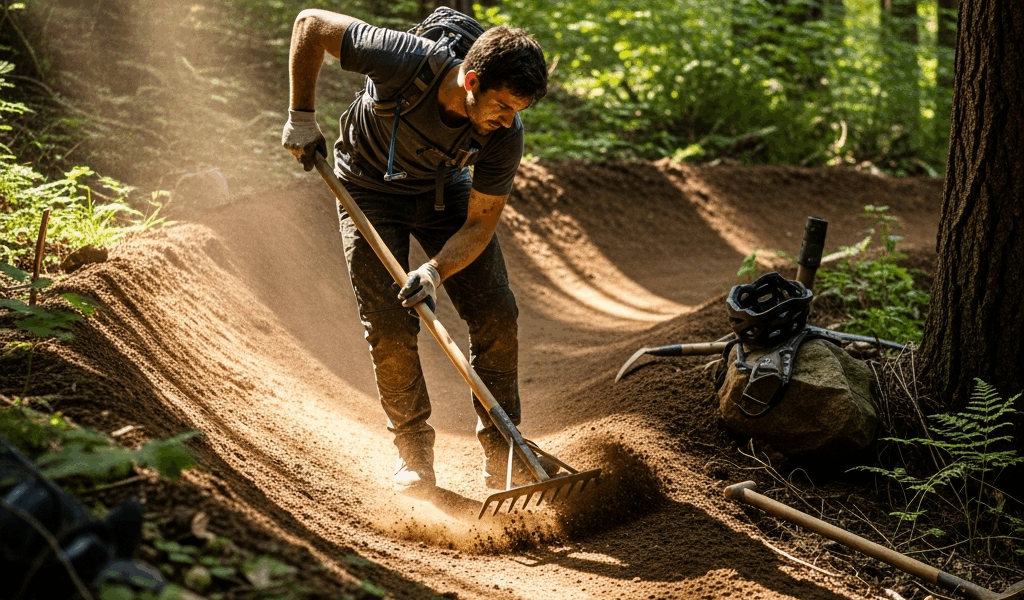
Trail building has gotten a bit mystified — people think you need professional equipment or a crew of experienced builders to do anything meaningful. As someone who’s spent time working on both formal IMBA sanctioned builds and informal property projects, I’ve learned that most of the principles are genuinely learnable and the biggest mistakes are consistently the same ones. Getting the fundamentals right separates built features that last from expensive dirt sculptures that fall apart the first wet season.
Sustainable Trail Design Principles First
Before you pick up a McLeod, understand why trail design matters. A trail built without regard for drainage will fail within a season — not metaphorically, but literally. Water is the enemy of trail surfaces. When water runs down a trail rather than off it, erosion follows. Every feature you build should direct water off the tread, not pool it or channel it along the middle.
The fundamental rule is grade reversal. A well-designed trail changes direction frequently enough that water sheeting down the tread rolls off the edge rather than channeling down the center. Straight descending trails are drainage nightmares. Probably should have led with this section, honestly — it’s the one thing that determines whether a trail still looks like a trail in five years or has turned into a creek bed.
“Grade reversals” — subtle undulations in the trail that dump water to the side — are the most important sustainable design tool. They’re not dramatic. You might not even notice them riding at speed. But the drainage they create is what makes everything else hold together.
Building Berms
A berm is a banked corner that lets you carry speed through a turn by providing a surface perpendicular to your direction of travel. Well-built berms are one of the most satisfying trail features to ride. Poorly-built ones are either unsafe, ugly, or both — and there are a lot of poorly-built ones out there.
The key dimensions: entry angle should match approach speed (faster approach = sharper angle to the banking), the apex should be at or just past the center of the turn radius, and the exit should flow back into the trail without an abrupt edge. The berm face should be compacted dirt over a solid soil base — not loose material piled up and hoped for the best.
Compact soil as you build. Every layer gets stomped or plate-compacted before you add more. Loose, uncompacted berms look done immediately after building and fall apart within weeks. Take the time to build from the base up correctly. The riders who hit it three weeks later will thank you, even if they don’t know to.
Building Tabletops
A tabletop is the most beginner-friendly jump feature: a ramp in, a flat landing surface, and a ramp out. If you under-jump it, you land on the flat top rather than in a gap. That’s what makes tabletops so much more forgiving than double jumps for skill progression — the worst case outcome is just a bumpier landing, not a crash into a gap.
Tabletop construction starts with defining the take-off lip angle (20–35° is appropriate for most trail speeds), building the table surface at the correct height for your approach speed, and setting the landing ramp at an angle that matches the typical flight arc — slightly steeper than the take-off, generally 35–45°. The distance from take-off to landing determines the jump distance. Calculate that based on your target speed, not your maximum speed.
Mark the landing zone for riders before opening the feature. First riders should roll over it slowly to assess the shape before anyone sends it at speed.
Gap Jumps — Advanced Only
Gap jumps have no flat top — just take-off, air, and landing. Under-jumping means landing in the gap. They belong only on trails designed for advanced riders, should be clearly marked, and require significantly more precision in construction to ensure the gap distance matches the achievable speed range. Don’t build these as a first project. Build and ride tabletops first, learn the geometry from the builder side, and then work up to gaps with experienced oversight.
Permissions and Legality
Most public land prohibits building unauthorized trail features. Doing so creates liability for you and generates the kind of conflict with land managers that affects the entire riding community’s access — not just yours. Work through proper channels: contact the land management agency, connect with your local trail club, join a sanctioned build. On private property with the landowner’s permission, you have more latitude. But consult with experienced trail builders before starting. Well-intentioned amateur construction creates features that are either dangerous or unsustainable at a rate that should give everyone pause.


Stay in the loop
Get the latest trail rise updates delivered to your inbox.