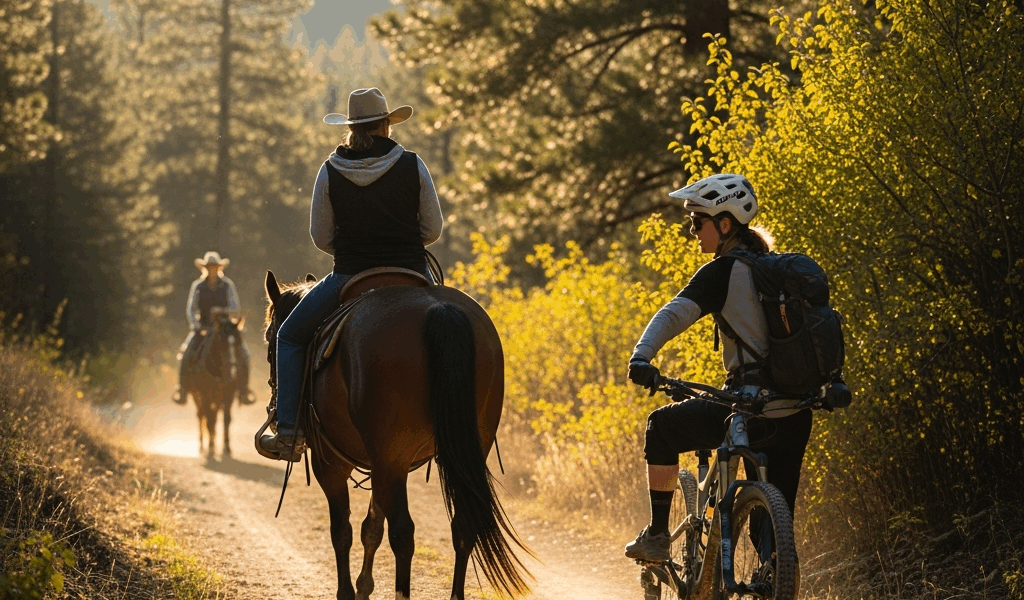
Multi-use trail sharing has gotten more complicated with all the new user types out there — e-bikes, trail running strollers, off-leash dogs with owners who swear they’re friendly. As someone who’s been riding with hikers and horses sharing the same dirt for a long time, I’ve learned what actually works and what just creates conflict. The rules aren’t complicated once you internalize the principle behind them: you’re a fast-moving vehicle in a shared pedestrian space.
The Standard Right-of-Way Hierarchy
The widely recognized right-of-way order on multi-use trails goes like this:
- Horses and equestrians — highest priority, always
- Hikers and pedestrians
- Mountain bikers
Mountain bikers yield to horses and hikers. This isn’t just a rule — it’s practical safety. Horses are prey animals that can spook dangerously when surprised by a fast-moving cyclist. A spooked horse on a narrow trail is a serious injury risk for the rider, and often for the horse.
Passing Horses — The Most Important Skill
When you encounter horses on trail, the protocol is pretty specific: stop your bike, move to the downhill side if you can, and talk to the equestrian like a human being. Ask “what would you like me to do?” Some horses are completely unbothered by bikes and you can pass normally. Others need you to stay completely still until they’re past you down the trail.
Don’t approach from behind at speed and brake late. That’s the fastest way to cause a dangerous situation. Announce yourself from a distance — something like “hello from behind, I have a bike, coming up slowly” — so the equestrian has time to manage their horse before you’re on top of them. I’m apparently loud enough that horses hear me coming from a reasonable distance, which works fine. Riders who are quiet and fast are the problem.
If a horse spooks despite your care, stay still. Rapid movement away from a spooked horse actually amplifies its panic response. Once the horse settles, ask the rider what they need next.
Passing Hikers
Mountain bikers yield to hikers under standard right-of-way, but the practical application varies by trail width. On wide trails or fire roads, you slow down, announce yourself, and pass with clearance. On narrow singletrack, yield means actually stopping and stepping aside.
Announcing your approach from an appropriate distance matters more than anything else. “On your left” from 50 feet gives hikers time to step aside calmly. “On your left” from five feet startles people into moving unpredictably — which is exactly when the collision you were trying to avoid happens. Bells work too, though some hikers prefer a voice so they know what’s coming.
Make eye contact when you pass and acknowledge the person. A brief “thank you” or “have a good one” takes half a second and changes that person’s impression of mountain bikers as a user group. That matters at the land manager level more than most riders think.
Uphill vs. Downhill Conventions
The traditional convention is that uphill riders have right-of-way over descending riders — a descending rider can find a stopping point, while an uphill rider loses momentum that’s hard to regain on technical ascents. In practice many descending riders just call out early and uphill riders yield anyway, especially on technical descent lines where stopping cleanly is more manageable going up.
The rule matters less than early communication. Call out your presence and direction early. If you’re descending and spot an uphill rider, announce yourself and ask if they have a stopping point coming up. Most riders manage this gracefully without needing a formal protocol.
Speed and Awareness — The Real Issue
The biggest source of multi-use trail conflict isn’t right-of-way confusion. It’s speed. Mountain bikers who descend at trail race speeds on shared trails, especially around blind corners, are the primary reason many trail systems restrict bike access. That’s what makes appropriate speed so important to us as a community — it’s not just personal safety, it’s access politics. Blind corners on multi-use trails require speeds low enough that you can stop within your sight line. That’s the rule. Ride like someone you can’t see is around every corner, because sometimes they are.



Stay in the loop
Get the latest trail rise updates delivered to your inbox.