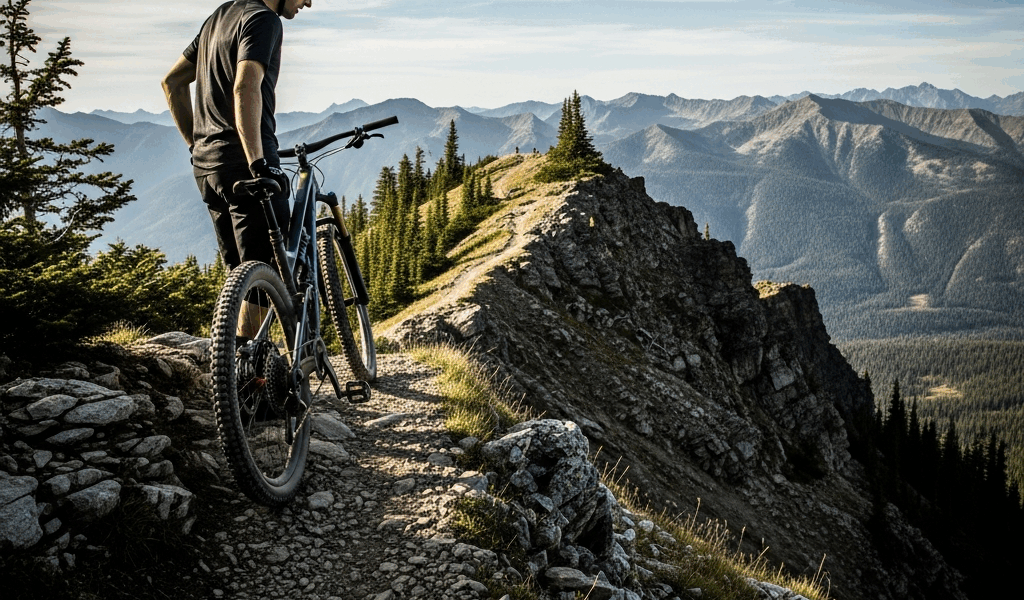
Trail fear is one of the most consistent experiences in mountain biking and one of the least talked about openly. As someone who has stood frozen at the top of technical features more times than I’d like to admit, and who has ridden with riders at every level from beginner to expert who all experience the same thing, I’ve learned that fear is completely manageable. It responds to the same kind of deliberate practice that improves any other riding skill.
What Fear Actually Is
Fear is your brain’s threat assessment system doing its job. When you approach a scary feature, your amygdala registers danger, floods you with stress hormones, and prepares your body for fight or flight. Your muscles tighten, your vision narrows, your breathing shortens. None of these are helpful on a mountain bike, which is part of what makes the fear response so frustrating — it’s precisely designed to do things that make technical riding harder.
The important thing to understand is that fear response isn’t based on actual danger — it’s based on your brain’s prediction of danger. Those predictions are often miscalibrated, especially for riders who are technically capable of the terrain in front of them but haven’t accumulated enough exposure to feel safe doing it.
The Freeze Response — What to Do at the Top
Standing at the top of a feature you’re scared of, frozen, is extremely common. Your brain is searching for certainty before it commits. The worst thing you can do is stand there longer — the longer you stall, the more your brain generates catastrophic scenarios about what could go wrong.
Practical approach: set a rule for yourself before you arrive at the feature. “I’m going to look at it once, walk it if I want to, and then either commit or ride away — no standing at the top for more than 30 seconds.” Decision fatigue and prolonged exposure to the scary view without action amplifies fear rather than diminishing it. I’m apparently someone who needs this rule explicitly stated before approaching anything that scares me, because without it I can stand there for an embarrassingly long time.
Visualization — Build the Mental Rep First
Elite riders in every discipline use visualization deliberately, and trail riding is no different. The technique before riding a scary feature: walk it, identify your line, pick your speed marker, then stand still with your eyes closed and run through a successful execution in your mind. See yourself entering, committing to the movement, landing clean, and riding away.
This isn’t motivational fluff — you’re building a motor program. Your brain can’t fully distinguish between a vividly imagined successful execution and a real one. A few mental reps reduce the novelty of the experience when you actually ride it. That’s what makes visualization endearing to athletes who were initially skeptical — the results are consistent enough to convince even the most evidence-focused riders.
Commit Fully or Don’t Go
Partial commitment is where most crashes happen. A rider who enters a drop uncertain, brakes halfway through, and lands with their weight back is in a far worse position than either a rider who commits cleanly or one who turns around. There’s a decision point before every scary feature — the time to back off is before you’re in motion, not during.
Knowing when to back off is a skill, not a weakness. The correct response to “I’m not ready for this yet” is to turn around, not to hope for the best. Forcing it scared and tensed up increases crash risk and reinforces the fear loop. None of that is progress.
Graduated Exposure — Building to the Scary Thing
The most reliable method for overcoming trail fear is systematic desensitization through graduated exposure. Start with features that are less scary and build progressively. If a specific drop is intimidating, find smaller drops on easier terrain and ride them until they feel routine. Then step up. Your brain recalibrates its threat assessment as it accumulates evidence that you can handle these features — that’s the actual mechanism.
Breathing — The Fastest Tool
When fear spikes, breathing becomes shallow and fast. Deliberately slowing your exhale activates the parasympathetic nervous system and directly counteracts the stress response. Before a scary feature: one slow breath, with a 4-second exhale. This isn’t relaxing in the conventional sense — it’s a fast physiological reset that brings your nervous system down just enough to allow skilled movement instead of frozen panic.
Skills Gaps Are Fear Generators
Often, fear of specific trail features is a proxy for a skills gap. Riders scared of drops usually lack a reliable drop technique. Riders scared of steep chutes usually haven’t worked specifically on brake control and weight distribution on steep terrain. Identify the skill that’s missing and address it deliberately in a low-stakes environment with coaching if possible. Fear often evaporates quickly once the underlying skill is solid — that’s probably the most useful thing to know about this whole subject.


Stay in the loop
Get the latest trail rise updates delivered to your inbox.