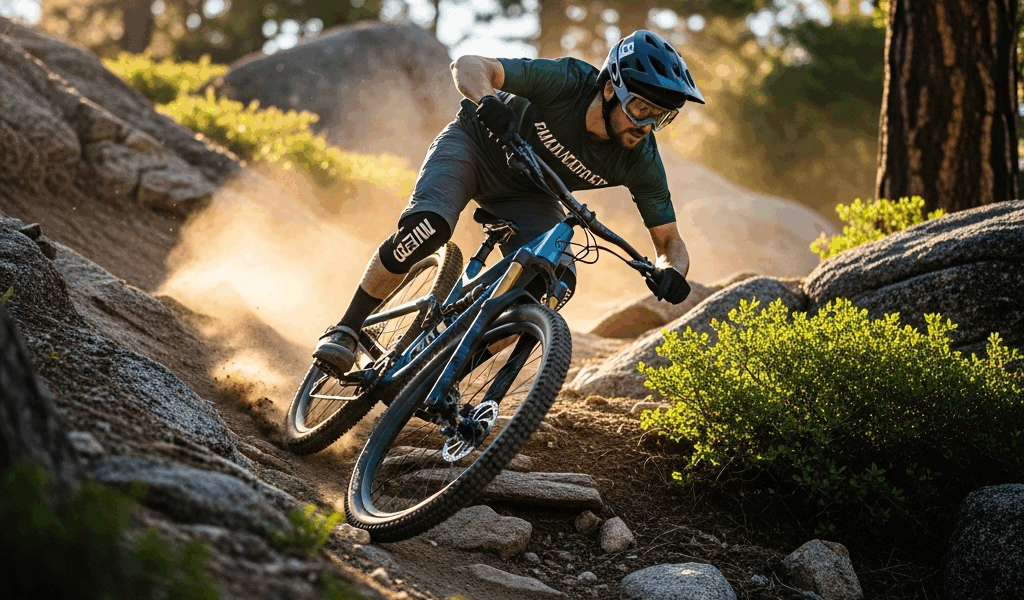
The mental side of mountain biking has gotten more attention over the past few years, but most riders still treat it as a soft add-on rather than something that actually determines performance. As someone who spent years working purely on physical fitness and technical skills while ignoring the mental layer entirely, I can tell you: the mental game is what determines whether your skills actually show up when the terrain gets hard. Here’s what I know actually works.
The Flow State — What It Is and How to Find It
Flow is the psychological state where performance feels effortless, time distorts, and you’re responding to the trail faster than conscious thought allows. Every experienced rider knows what it feels like. The frustrating part is that flow can’t be forced — trying too hard to enter it pushes it away. That’s what makes it feel mysterious when it’s actually quite consistent if you create the right conditions.
The conditions that produce flow: challenge level slightly above your current comfort zone (too easy = boredom, too hard = anxiety), complete concentration on the present moment, and clear feedback from your actions. The trail provides that feedback constantly. Your job is to get out of the way of your own nervous system and let it do what it’s already learned to do.
Reduce mental clutter before you ride. A five-minute transition between arriving at the trailhead and hitting the trail — phone away, run through your pre-ride checklist slowly, a few deliberate breaths — creates a cleaner mental state to work from. I’m apparently someone who needs this ritual more than most. Without it I spend the first 20 minutes of every ride thinking about work.
Focus — Where Your Eyes Go
Where you look is where you go. This is not a metaphor — it’s a biomechanical fact. Your body follows your visual focus. Riders who look at the rock they want to avoid hit the rock. Riders who look at the landing zone reach the landing zone.
Trail focus should be 15–30 feet ahead, scanning for the line — not staring at what’s immediately in front of the wheel. Your eyes need enough lead time to select a line and initiate the body position changes required to execute it. Looking too close forces reactive, late responses. Looking ahead creates proactive, fluid riding. Practice this deliberately on easy trails: force your gaze forward. It feels wrong at first. Your feet adapt to the terrain through peripheral vision and learned body awareness faster than you’d expect.
Self-Talk — The Constant Background Track
Every rider has an internal voice narrating their riding. For struggling riders, that voice tends toward criticism, prediction of failure, and rumination on past mistakes. For strong riders, that voice tends toward process cues, encouragement, and present-moment focus. You can’t eliminate self-talk, but you can redirect it.
Process-oriented self-talk (“push heels down, look to the exit, light hands”) outperforms outcome-oriented self-talk (“don’t crash, don’t mess this up”) in every documented study on the subject. When you catch critical or anxious self-talk, don’t fight it — note it and deliberately replace it with a process cue. That’s the whole technique. It’s simple and it works.
Pre-Ride Rituals
Consistent pre-ride rituals create a reliable psychological on-ramp to riding. The specifics matter less than the consistency. Many riders use: gear check, a short warm-up loop on easy terrain, two or three technique reminders specific to what they’re working on. Running the same ritual before every ride triggers the neural pathways associated with riding well. That’s what makes pre-ride rituals endearing to performance-oriented riders — they’re not superstition, they’re neural priming.
Managing Bad Days
Some days the flow just doesn’t come. You’re one beat off — slightly late on every feature, losing confidence as the ride goes on. This happens to every rider. The worst response is to push harder on scary features trying to force good riding — this is reliably when crashes happen.
On a bad day: back off the intensity, ride familiar easy trails, focus on technique rather than challenge. A 90-minute ride where you execute your fundamentals well on moderate terrain does more for your development than a scary three-hour sufferfest where your technique deteriorates throughout. Knowing when to dial back is a skill, not a weakness.
Post-Ride Review
Brief post-ride review — five minutes, not a full debrief — accelerates improvement significantly. Note two or three things that went well and one thing to work on next time. Ending with what went well keeps motivation high over a long season. Most riders skip this entirely, which means they’re leaving one of the most effective development tools on the table every single ride.


Stay in the loop
Get the latest trail rise updates delivered to your inbox.