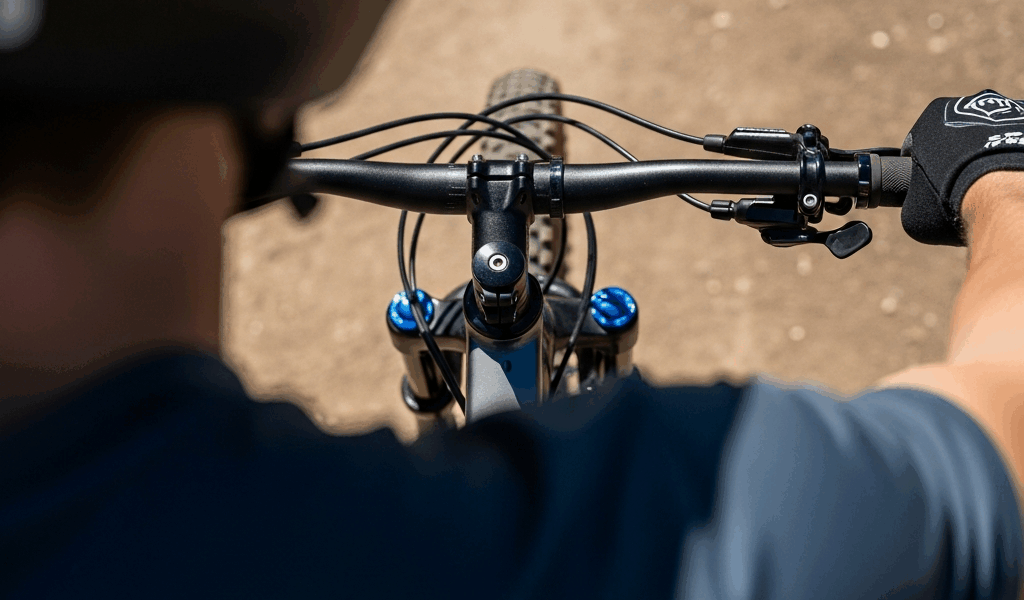
How to Tell If Your Bars Are the Wrong Width
MTB handlebar sizing has gotten complicated with all the conflicting advice flying around. Everyone’s got an opinion. Wider is better. No, narrower is faster. Go with what feels right. Not exactly helpful when your shoulders are on fire by mile eight.
That’s exactly what happened to me last season — third long ride in, and I’m convinced I’m just out of shape. My shoulders were screaming. My forearms were toast. A buddy watched me ride for about thirty seconds and said, “You’re white-knuckling those bars like you’re going off a cliff.” Turns out my 820mm bars were just wrong for my build. Classic case of wrong width, wrong body, wrong day.
Here’s what wrong-width bars actually feel like:
- Shoulder fatigue on rides over 90 minutes, even when you’re fit
- Twitchy steering on technical terrain — bars feel darty and hard to control smoothly
- Arm pump on climbs that shouldn’t exhaust you, especially your forearms
- Feeling cramped like you’re hunched forward, or stretched out like you’re reaching for something just beyond the bars
- Dead hands from gripping too hard to compensate for unstable steering
Most riders assume wider bars are always better. They’re not. Too wide and you’re fighting your own leverage all day. Too narrow and the bike gets squirrelly through rough sections. I’ve ridden 800mm bars that felt like airplane wings bolted to a trail bike. I’ve also ridden 680mm bars on a hardtail and felt like I was steering a kayak through boulders. Both are bad. Both are fixable.
Simple diagnostic: consistent discomfort matching the list above points to bar width. Pure hand numbness with no shoulder fatigue? That’s usually grips or a stem that’s too long — different problem entirely.
Measure Your Shoulder Width the Right Way
Grab a tape measure. Find your AC joints — those bony bumps where your collarbones meet your shoulders. Measure straight across, side to side, behind your neck. Write that number down. That’s your baseline.
Most riders fit best on bars roughly equal to shoulder width, sometimes 20mm wider. An XC racer sitting at 680mm shoulder width will typically ride 700–740mm bars. Trail riders in the 730mm range usually land between 760–780mm. Enduro and DH riders add another 20–30mm on top of that for stability in rowdy terrain.
Here’s a practical reference:
| Riding Style | Typical Bar Width | Shoulder Width Range |
|---|---|---|
| XC / Racing | 720–740mm | 650–700mm |
| Trail Riding | 760–780mm | 710–750mm |
| Enduro / All-Mountain | 780–800mm | 750–790mm |
Your measurement won’t be a perfect prescription. Arm length, riding position, personal preference — all of it nudges things around. But it kills the guesswork. You walk into a shop knowing that 760mm probably fits you, instead of hoping some random recommendation applies to your body and your geometry.
Cut Your Bars Down — Step by Step
So you’ve measured. Your 820mm bars are clearly too wide. Time to cut. And honestly — I’ve botched this twice. Don’t make my mistake. Both times I marked one side, eyeballed the other, and assumed they matched. They didn’t. Rode around for a week wondering why the bike felt weird before I actually measured the result.
Mark both sides first. Measure from the bar’s center point out to each end. Targeting 760mm total? That’s 380mm from center to each cut. Use a Sharpie and a straight edge — a scrap block of wood does the job fine. Wrap the line all the way around the bar. Check it from multiple angles. It should look level from every direction.
Choose your cutting method. A pipe cutter is fastest on aluminum — tighten gradually, rotate, tighten again. Don’t crank it down on the first pass or you’ll deform the end. A fine-tooth hacksaw works too. Slower, but you’ve got more control. Either way, cut on the waste side of your line. Not the keep side.
Deburr the edge. A file or 120-grit sandpaper knocks down the sharp lip left after cutting. Takes two minutes. Skipping it means shredded grips in three rides.
Carbon bars are a different situation entirely. Never run a pipe cutter on carbon — you’ll crush the fiber layers and wreck the bar’s structural integrity. Use a fine-tooth hacksaw, wrap blue painter’s tape around your cut line first to hold the fibers together, and file gently after. The edge comes out sharper than aluminum and more fragile. Treat it accordingly.
Reinstall your grips, get the stem torqued back to spec — usually 4–5Nm for a 31.8mm clamp — and take it out for a ride. If bar width was the actual problem, you’ll feel it immediately.
What to Do If Your Bars Are Already Too Narrow
Maybe you cut too aggressively. Maybe you picked up a used bike with bars sized for someone built nothing like you. Either way — you can’t un-cut aluminum. Bar ends aren’t a real solution on modern flat bars either. They shift your hand position in ways that mess with steering geometry and honestly just feel wrong after about twenty minutes.
The straightforward answer is a new bar. Aluminum options — something like a Deity Ridgeline or a Race Face Aeffect — run $35–$80. Carbon bars, like a Renthal Fatbar Carbon or OneUp Carbon, land between $80–$200. Both are cheaper than a physio appointment for shoulder issues you’ve been ignoring for two months.
One thing most people miss: swapping bar width changes your effective reach. A 20mm wider bar paired with a 60mm stem versus a 40mm stem puts you in a completely different position on the bike. Check your stem length any time you change bar width. That interaction matters more than most riders realize.
When Bar Width Is Not the Real Problem
Probably should have opened with this section, honestly. Bar width gets blamed for a lot of problems it had nothing to do with.
Stem too long? You’ll feel stretched and overreaching — especially on steep climbs. A 40mm or 50mm stem swap fixes that. Around $20–$40, and it takes fifteen minutes.
Bar rise too low? Your back rounds, your shoulders ache, and everything points to bars being the culprit. Sometimes it’s just bar height. A 20mm stem spacer costs $15 and takes five minutes to test. A higher-rise bar — going from 20mm to 35mm rise — moves you up without touching width at all.
Grips worn smooth? Your hands slip under load. You squeeze harder to compensate. Your forearms blow up. It feels exactly like bars that don’t fit — but the actual problem is $35 away. I’m apparently a lock-on grip person, and the Ergon GE1 Evo works for me while flanged grips never quite do. Your mileage will vary, but don’t skip this check.
Before cutting anything, ask yourself: Is this shoulder fatigue from fighting leverage, or are my hands sliding because the grips are dead? Am I stretched out horizontally, or does the bike just feel too low? Does the twitchiness happen everywhere, or only on chunky rock gardens? Those questions separate an actual bar-width problem from a stem or grip problem wearing a different mask.




Stay in the loop
Get the latest trail rise updates delivered to your inbox.