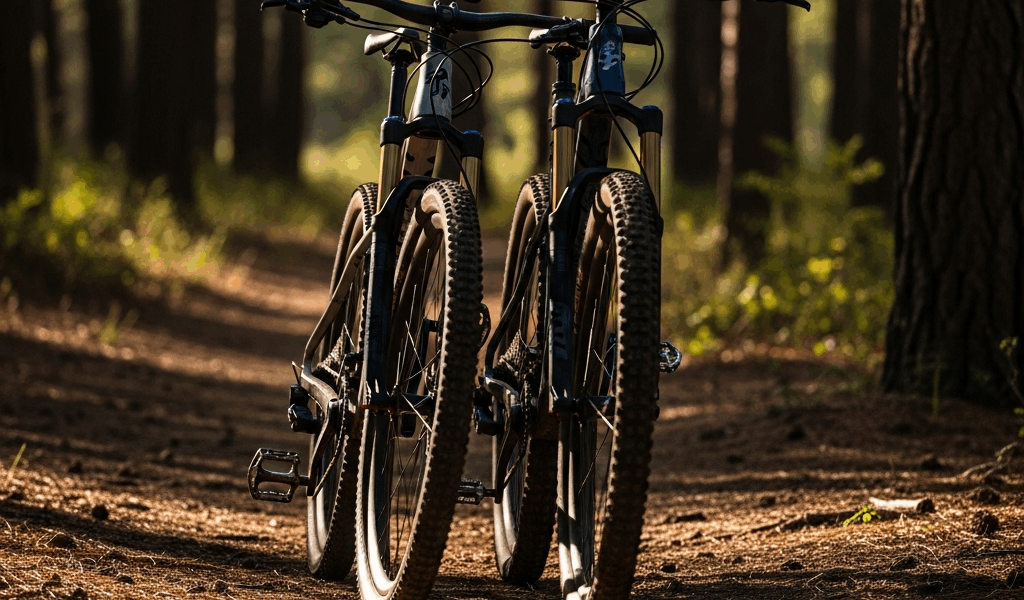
Hardtail at $1500 or Full Suspension at $1500 — The Real Question
Buying your first real mountain bike has gotten complicated with all the spec-sheet noise and YouTube influencer opinions flying around. I spent three seasons making the wrong call for myself — not wrong like broken, but wrong like I kept chasing what looked cool instead of what actually fit where I was as a rider. Fifteen hundred dollars sounds like real money until you’re standing under fluorescent lights at a bike shop, trying to figure out whether to put it toward suspension travel or a frame that won’t flex every time you lean into a corner.
So here’s what I figured out the hard way: at $1500, you’re not really asking “hardtail or full suspension?” You’re asking whether you want a genuinely excellent hardtail or a full-suspension bike that promises things it can’t quite deliver.
A $1500 hardtail is a real bike. A $1500 full suspension is mostly a sales pitch.
Full suspension needs two complete wheel assemblies, rear shock hardware, linkage systems, and all the manufacturing tolerance that goes with them. That costs money — real money. Divide $1500 across that platform and something has to go. Usually it’s the fork internals. Sometimes the shock. Often both, plus the drivetrain. You end up with suspension on paper and suspension components that actively work against you on the trail.
Put that same $1500 into a hardtail? It goes into a stiff frame, an air-sprung fork, a Shimano Deore 1×12 drivetrain, and geometry that was actually engineered to work together. You ride faster. You build confidence. You’re not spending your first season cursing a fork that bobs on climbs and wallows through rock gardens.
Most beginners — and I was absolutely this person — don’t yet know what terrain they’ll actually ride regularly or what riding style will click for them. You might be convinced you need full suspension right now. Then you get on the trail and realize you’re chasing flow, not soaking up rock gardens. Or you find out your local network is mostly hardpan and rooted singletrack, which is exactly where hardtails shine. Or you discover you hate the idea of servicing a rear shock every season.
Full suspension makes sense. Just not at $1500. We’ll cover it anyway — maybe you’ve got specific reasons I’m not thinking of. But be straight with yourself first: do you actually need it for the riding you’ll do, or do you just assume more suspension equals better bike? Most beginners assume the latter. I did.
Best Hardtails Under $1500
Giant Talon 2 (Around $999–$1200)
The Talon 2 is where I’d put my money if I were starting over from scratch. Not the flashiest name on the wall. Not the one with the most aggressive graphics. It’s the one that nails the fundamentals without pretending to be a $3,000 trail bike in disguise.
The aluminum frame runs a slackish head tube angle — somewhere in the 67–68 degree range depending on size — with a reach that doesn’t feel cramped or weirdly stretched out. That’s what makes the Talon endearing to us beginner-to-intermediate riders who are still learning what “good geometry” even means. The fork is a Suntour XCR, air-sprung, 100mm of travel. Air matters. Air forks outperform coil at this price in almost every measurable way — lighter, easier to tune, more responsive over small chatter. The drivetrain is Shimano Deore 1×12. Twelve speeds, one chainring, done.
Tires are Maxxis — which is genuinely a good sign about how Giant speced the rest of the build. Brakes are Shimano hydraulic disc. Nothing exotic, but they stop the bike reliably and the pads are cheap and easy to find when they wear down.
Nothing on this bike is weak. No weird proprietary interfaces. No fork that feels like it’s packed with rubber bands. No drivetrain that came with the frame because it was cheaper than cardboard. The Talon is honest — it’s a solid trail hardtail built for someone who wants to learn to ride well without fighting their equipment the whole time.
Weight sits around 26.5 pounds depending on frame size. Light enough to get up climbs without hating yourself. Heavy enough that you’re not babying it over every rough patch.
Trek Marlin 7 (Around $1099–$1300)
Trek built the Marlin line specifically for beginners. That sounds like a dismissal — it isn’t. They built this bike to work, not to impress people at the trailhead.
The Marlin 7 comes with a RockShox Judy fork — air-sprung, 100mm of travel, tuned to match the frame rather than just dropped in from a parts bin. Frame geometry pushes slightly more aggressive than the Talon: longer reach, slacker head angle. This is a bike that’s already tilting toward slightly more technical terrain without going full enduro-weird about it.
Drivetrain is Shimano Deore 1×12. Brakes are Shimano hydraulic disc. Tires are Bontrager house brand, which is fine — Trek controls its component sourcing tightly enough that there’s usually a quiet quality floor built into everything.
The real argument for the Marlin over its competitors is Trek’s dealer network. If something snaps or wears weird in month three — and something always does — you’re probably within driving distance of a Trek dealer who can sort it out. That matters more than new riders expect. Warranty support on a beginner bike isn’t a luxury. It’s a practical safety net.
The Marlin 7 is slightly more trail-aggressive than the Talon, which is the right call if you think you’ll get restless on cross-country trails within your first season. It’s also generally easier to find in stock, which is a real consideration worth thinking about before you fall in love with a specific colorway that’s backordered until June.
Specialized Rockhopper Expert (Around $1200–$1400)
Specialized built the Rockhopper to do exactly what the Talon and Marlin do — get people onto their first real mountain bike and send them back three years later ready to spend more money. There’s no shame in that. It’s a good bike.
You want the Expert model, not the base Comp. The Expert runs a RockShox 30 Gold fork — air-sprung, genuinely decent, not a placeholder. Drivetrain is Shimano Deore 1×12, same standard as the others. The geometry here is slightly more conservative than the Marlin: a bit less aggressive head angle, shorter reach. If you’re genuinely uncertain how aggressive you want to go, the Rockhopper is the safer call. It’s a bike that keeps you from getting pushed into terrain you’re not ready for before you’ve built the skills to deal with it.
Build quality finish is noticeably better than the competition at this price. Cable routing is cleaner. Paint feels thicker. The headset doesn’t develop slop after a month of use. Those are small things — but small things accumulate when you’re new and still figuring out what’s normal bike behavior versus something you should be worried about.
Probably should have opened with this section, honestly: Specialized sizing runs small. A size medium Rockhopper fits more like a small in Trek or Giant. I’m apparently a large in every other brand and an XL in Specialized, and that threw me off completely the first time I tried one. Don’t make my mistake — go sit on one in person before you commit to a size online.
Best Full Suspension Under $1500 — If You Must
Giant Stance (Around $1300–$1499)
If full suspension at this price is non-negotiable for you, the Stance is the one that makes the most sense. Not because it’s perfect — because everything else at this price point is worse.
The Stance runs an aluminum frame with 120mm of travel front and rear. That’s a reasonable trail number — enough to absorb real impacts without eating into pedaling efficiency so badly that every climb feels like you’re riding through wet sand. Frame stiffness is actually decent for the price.
But what is $1500 full-suspension fork quality? In essence, it’s a Suntour XCM — coil-sprung, heavier than air, with minimal damping control and a spring tuned for some hypothetical average-weight rider. But it’s much more than a weight complaint: coil forks at this price don’t give you meaningful rebound or compression adjustment. If you’re lighter or heavier than whatever baseline they designed around — say, anywhere outside 150–180 lbs — you’ll feel that mismatch on every ride. The rear shock is a Suntour NVX. Same story. Basic internals, limited adjustability.
In practice, the suspension absorbs impacts. It won’t feel refined doing it. On climbs you’ll notice the suspension bobbing when you want it locked out — and there’s no lockout lever. You’ll spend your first few rides wondering if something’s mechanically wrong. Nothing’s wrong. That’s just what $300 worth of suspension components feels like when they’re working as designed.
Drivetrain is Shimano Deore 1×12. Brakes are Shimano hydraulic. The frame geometry is modern and confident. If you can genuinely make peace with the suspension limitations, it’s a functional trail bike. Ask yourself one more time though: are you buying this for the specific terrain demands of your actual local trails, or because more suspension feels like a smarter purchase?
Vitus Mythique (Around $1299–$1499)
Vitus sells direct-to-consumer, which is why the price is lower than a comparable Giant or Trek. Less dealer markup. More bike per dollar. Also why you’ve probably never heard of them.
The Mythique is their entry full-suspension — aluminum frame, 120mm front and rear, Suntour NVX fork and rear shock. So: coil-sprung, basic damping, same suspension compromises as the Stance. Maybe marginally better value because the whole package costs slightly less and the frame geometry leans a bit more confident on technical terrain.
Drivetrain is Shimano Deore 1×12. Brakes are Shimano hydraulic disc. The spec sheet looks nearly identical to the Stance.
That’s what makes the direct-to-consumer model endearing to us budget-conscious riders — you’re genuinely getting more frame and component per dollar spent. The tradeoff is support. When something breaks — and something will, on any bike — you’re either shipping it back or hunting for a local shop willing to work on a brand they didn’t sell you. For beginners who need someone to help figure out why the rear derailleur is suddenly skipping, that’s a real practical problem. If you’re mechanically confident or have a friend who wrenches on bikes, the Vitus makes sense. If you need a dealer relationship, stick with Giant or Trek.
What Matters at This Price Point
Air Fork Versus Coil — The Fork Question
Spend $1500 and you get to allocate that money toward one thing that’s actually excellent. Make it the fork.
Air-sprung forks are lighter — typically by half a pound or more — easier to set for your specific weight, and more responsive over small repeated bumps. Coil-sprung forks are heavier, harder to tune without buying different spring weights, and tend to feel vague at trail speeds. The Suntour XCR on the Talon and the RockShox Judy on the Marlin are both air-sprung. The Suntour XCM on the Stance is the coil fork you end up with when the budget gets split across a rear shock and linkage hardware.
All these forks run 100–120mm of travel. That’s enough — more isn’t automatically better here. More travel at this price means slower rebound, which means the fork doesn’t recover fast enough between bumps, which means you end up feeling bouncy and out of control rather than composed. Stick with 100–120mm and spend the fork budget on air-sprung internals instead of extra travel numbers.
Drivetrain — 1×12 Is Standard Now
Five years ago this was a longer conversation worth having. Now? All three hardtails run Shimano Deore 1×12. One chainring. Twelve speeds. This is the settled standard for trail bikes under $1500 — so, without further ado, let’s dive into why that matters.
The range covers steep climbs on the low end and fast descents on the high end without making you manage a front derailleur. One shifter. One derailleur. Less to adjust and less to break. The parts ecosystem is enormous — replacement chains are around $15–20, cassettes are $40–60, and any shop carries spares. If you ever want to upgrade to a lighter cassette or a clutch derailleur, there’s a whole market of compatible components at every price point.
One detail worth checking: make sure the cassette range isn’t making huge gear jumps between steps. Deore 1×12 typically runs a 10-51t range — that’s fine. Some cheaper budget setups use a wide-range cassette where the jumps between individual gears feel jarring and weird when you shift. It’s worth confirming before you buy, especially on any closeout or older stock.
Dropper Post — This Should Be Non-Negotiable
A dropper seatpost is a lever on your handlebar that drops your saddle down while you’re riding. First time someone described that to me, it sounded like a gimmick. It isn’t — it’s probably the single biggest thing that determines whether a beginner develops good riding habits or bad ones.
Descending with your saddle at climbing height means your weight is too high, your body has no room to move, and you’ll get bucked between the seat and the bars every time the trail gets rough. That’s where beginners start squeezing the brakes early and building defensive habits that take years to undo. Drop the seat and suddenly you’re centered, balanced, and moving with the bike instead of fighting it.
All three hardtails mentioned come with dropper posts as standard equipment. Good — that’s how it should be. Most full-suspension bikes at this price don’t include one, which is another real-world compromise worth factoring in. Add $150–$200 for a quality mechanical dropper if your bike doesn’t come with one — brands like PNW Components or TranzX make reliable options around that price. That changes the actual cost comparison between builds.
Droppers at this price are mechanical cable-actuated, not hydraulic. Engagement is slightly slower than a hydraulic unit. That’s fine — simpler, more reliable, and easier to adjust yourself when the cable stretches after a few months of use.
Tire Clearance — Room to Grow
The bikes listed here run 2.3″ or 2.4″ tires as stock — that’s standard trail width. What matters more than the stock tire is whether the frame has room for something different down the road.
As you ride more, you might want wider tires for loose terrain or a narrower faster tire for hardpack. A frame that maxes out at 2.25″ locks you into a narrow range of options. A frame that clears 2.6″ gives you real flexibility to experiment. The Talon and Marlin both have solid clearance in this regard. The Rockhopper runs slightly tighter tolerances. The Stance and Mythique have more room, partly because full-suspension frames don’t run their chainstays as close to the tire.
Small thing. But small things stack up when you’re new and still working out what your local trails actually demand from a tire.
The Verdict — Buy the Hardtail
I learned this lesson wrong twice. First bike was a cheap full-suspension with basic components — spent two seasons believing I just wasn’t a very good rider. Turned out I was fighting a bike that wasn’t built to reward learning. Second bike was a decent hardtail. Suddenly I could actually feel what I was doing wrong, and more importantly, I could feel when I got something right.
At $1500, a hardtail gives you genuinely better components — not as an opinion, as a parts-cost reality. The frame costs less to build, so the fork, drivetrain, and wheels get more budget. You get a nicer fork. Better brakes. Wheels that hold true longer. That’s not marketing. That’s where the money goes when it’s not split across a rear shock and linkage hardware.
A hardtail demands better riding. That sounds like a punishment — it’s actually the whole point. When there’s no rear suspension to smooth over a bad line choice, you learn to pick better lines. You learn to control your speed earlier. You develop feel for what the trail is actually doing under you. By the time you’re ready for your second bike, you’ll know exactly what you want from full suspension because you’ll know exactly how you ride.
A hardtail costs less to maintain. One set of suspension seals instead of two. No annual rear shock service. No linkage bearing replacement every couple of seasons. For someone still deciding how deep they want to go into this hobby, that matters.
A hardtail holds value better. The used market for hardtails is deep and active — simple, durable bikes that people actually want to buy secondhand. A Talon or Marlin purchased at $1200 will sell for $650–$750 in three years. Entry-level full suspension loses value faster because anyone shopping used bikes can immediately see that the suspension components are entry-level.
My actual recommendation: buy the Giant Talon 2 or the Trek Marlin 7. I’m apparently a Giant rider by preference and the Talon works for me while the Marlin never quite felt dialed-in, but honestly both bikes are right. The Talon is slightly better value. The Marlin has slightly better dealer support and a touch more aggressive geometry. Either one is the correct choice. Ride it for two solid seasons, build your skills on it, then upgrade to full suspension when you know what you actually want and you’re ready to spend real money on components that will actually perform.
That’s not hedging. That’s pattern recognition from making every mistake a beginner can make — twice.


Stay in the loop
Get the latest trail rise updates delivered to your inbox.