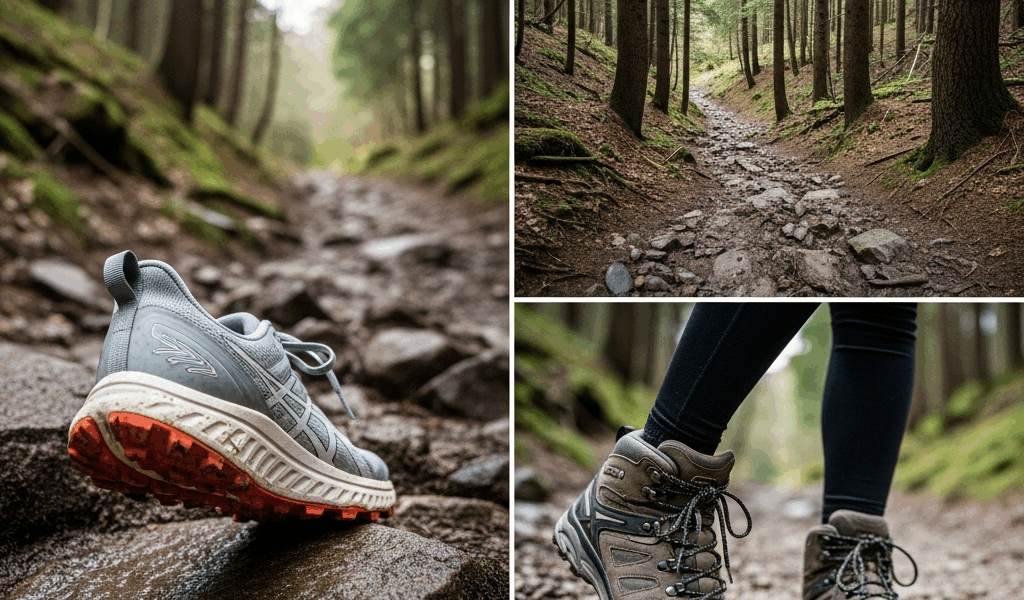
Trail Running Shoes vs Hiking Boots — Which Footwear for Your Next Trip
The Short Answer — Trail Runners for Most Day Hikes, Boots for Heavy Packs
The trail running shoes vs hiking boots debate has gotten complicated with all the conflicting advice flying around — forums, YouTube gear reviews, ultralight blogs telling you boots are dead, old-school hikers insisting you’ll destroy your ankles without them. Most of the time, the answer is simpler than people make it. Trail runners are the right call for about 90% of day hikes. Full stop. If you’re heading out on a well-maintained trail with a daypack under 25 pounds, you do not need ankle-high leather boots. You just don’t.
As someone who has been hiking in both for close to fifteen years — everything from casual fire road walks to Class 3 scrambles in the Cascades — I learned everything there is to know about matching footwear to actual conditions rather than imaginary worst-case scenarios. Today, I will share it all with you. Fair warning: I burned through two pairs of Vasque Breeze III boots before I finally stopped defaulting to heavy footwear out of habit. Don’t make my mistake.
Here’s the real framework. Trail runners win when your pack is light and the trail is reasonable. Boots win when your pack is heavy, the terrain is genuinely technical, or you’re out for multiple days in cold wet conditions. Everything else is noise. So, without further ado, let’s dive in.
This article includes affiliate links. We may earn a commission at no extra cost to you.
When Trail Runners Win
Picture a standard summer day hike. Eight miles, 1,800 feet of elevation gain, mix of dirt singletrack and some loose gravel. Temperatures around 65°F. You’re carrying 18 pounds — water, lunch, a rain shell, the usual. This is where trail runners aren’t just acceptable. They’re the better choice.
The Weight Difference Is Not Small
A typical trail running shoe — something like a Salomon Speedcross 6 or a Hoka Speedgoat 5 — weighs somewhere between 20 and 26 ounces per pair. A solid mid-cut hiking boot like the Merrell Moab 3 Mid or the Keen Targhee III Mid clocks in at 2.5 to 3.2 pounds per pair. That’s roughly a pound difference on your feet.
Sounds minor. It’s not. There’s a rule of thumb that one pound on your feet equals five pounds on your back in terms of fatigue. I’m apparently sensitive to this more than most people, and switching from my old leather Lowas to a pair of Brooks Cascadia 17s for a 10-mile ridge hike made my legs feel noticeably fresher at the end of the day. The math is real enough to matter — at least if you care about how you feel on mile nine.
Trail Scenarios Where Trail Runners Make Sense
- Day hikes under 10 miles on maintained trails
- Warm, dry conditions where waterproofing adds weight without benefit
- Packs under 25 pounds
- Trails with a lot of runnable sections — where you naturally speed up on the descents
- Summer alpine routes that are steep but not scrambling-level technical
- Any hike where you care about moving fast
The breathability angle matters more than people expect. Gore-Tex boots keep water out beautifully — until they don’t. I’ve had Gore-Tex boots fill with water on a creek crossing and stay soggy for the remaining six miles. The waterproofing that keeps water out also traps it in once it clears the collar. Trail runners dry out faster. On a hot July trail in Colorado, your feet will sweat regardless of what you’re wearing. That’s what makes breathable mesh uppers so endearing to us warm-weather hikers.
Fast and Light Backpacking Is Its Own Category
Worth mentioning — ultralight backpackers running 15 to 20 miles per day with 20-pound base weights have been wearing trail runners on multi-day trips for years. Thru-hikers on the PCT and CDT made the shift to trail runners over a decade ago. That was a genuine cultural shift in how serious hikers think about footwear, and it stuck. This isn’t fringe experimentation. It’s established practice for people covering serious mileage.
When Boots Win
Boots have real advantages. I’m not making the case that trail runners are always the answer. Heavy packs change the physics of hiking in ways that genuinely matter.
The Pack Weight Threshold — Around 30 Pounds
Probably should have opened with this section, honestly, because this is the clearest decision point in the whole footwear question. When you load up a 35-pound backpacking pack and step onto uneven terrain, the torque on your ankle joint is substantially different from what you feel with a daypack. Ankle support isn’t just marketing language boot companies invented — it’s relevant when you’re carrying real weight over rocks, roots, and uneven ground for six hours straight.
If your pack weighs more than 30 pounds, get boots. The support structure of a mid or high-cut boot — especially one with a stiff midsole — transfers load more efficiently and gives you meaningful protection against ankle rollovers on rough trail. That’s not a small thing after hour five.
I learned this the hard way on a three-day trip through the Enchantments in Washington State, carrying about 38 pounds including food and camera gear. I wore trail runners because I’d read enough ultralight blogs to convince myself it was fine. Rolled my ankle twice on the second day on wet granite slabs. Wasn’t a serious injury, but it slowed me down and made the last eight miles more stressful than they needed to be. Boots were the right call for that trip. Don’t make my mistake.
Conditions That Favor Boots
- Multi-day backpacking with a pack over 30 pounds
- Wet, muddy trails where waterproof construction actually earns its keep
- Cold conditions — below freezing — where insulated boots matter for warmth
- Rocky, technical terrain with a lot of loose scree or boulder hopping
- Off-trail travel where you’re not on a maintained path
- Trips involving river crossings in cold water
The Ankle Support Question
But what is ankle support, really? In essence, it’s the structure around your joint that limits lateral movement under load. But it’s much more than that. Some people argue the support from boots is mostly mythological — that strong ankles from deliberate training matter more than collar height. There’s some evidence for that position. Here’s what’s also true: if you hike two weekends a month rather than running trails three times a week, your ankles aren’t conditioned for heavy pack hiking in low-cut shoes. Boots compensate for that gap. Strong ankles and a light pack? Trail runners. Moderate fitness and a heavy load? Boots are providing real insurance.
Technical Terrain and Scrambling
Certain terrain types genuinely demand stiffer soles. Talus fields, loose shale, routes with any hand-and-foot climbing — a stiff-soled boot gives you a platform a flexible trail runner can’t match. Trying to edge on a narrow ledge in a flexible trail runner is uncomfortable in a way that’s hard to describe until you’ve done it. A boot sole that doesn’t flex under load lets you stand on a small feature without your foot folding around it. That’s not a minor comfort thing. That’s safety.
The Durability Tradeoff
This is the part of the conversation that often gets skipped in favor of discussing cushioning technology and outsole rubber compounds. Durability is a real financial consideration — at least if you hike more than a handful of times a year.
Trail Runner Lifespan — 500 to 750 Miles
Most trail running shoes are built with the same construction priorities as road running shoes: light, cushioned, responsive. That means EVA foam midsoles that compress over time, mesh uppers that wear through, and rubber outsoles that smooth out on abrasive surfaces. Plan on replacing them every 500 to 750 miles. Some shoes are closer to 400 on the low end if you’re regularly on rocky terrain.
A pair of Hoka Speedgoat 5s runs about $155. If you hike 300 miles a year — call it 25 to 30 day hikes — you’re replacing them every two years, spending roughly $75 to $80 per year on shoes. Manageable, but it’s a recurring cost worth factoring in. I’m apparently someone who runs through shoes faster than average, and the Speedgoat never quite lasts me a full two years on rocky Pacific Northwest trails.
Boot Lifespan — A Different Category Entirely
A quality full-grain leather boot with a Vibram outsole will outlast multiple pairs of trail runners. The Lowa Renegade GT Mid — around $250 — is realistically good for 1,500 to 2,000 miles with proper care. Occasional leather conditioning, keeping them dry between trips, resoling when the upper is still solid. Plenty of hikers get five-plus years out of boots in that range. That was unthinkable to me until I actually did the math.
Broken in properly, a leather boot also conforms to your foot over time in a way synthetic shoes never quite manage. The upfront cost is higher. The cost per mile is actually lower.
Frequency Matters Here
If you’re hiking 10 to 15 times a year, trail runners are perfectly economical and the durability gap doesn’t hurt much. Hike 40 to 50 times a year and churning through trail runners gets expensive — and slightly annoying, honestly, because you’re constantly breaking in new footwear instead of using shoes already molded to your foot. High-frequency hikers often find boots make more financial sense over a three-year window, even with the higher sticker price.
There’s also the resole factor. Quality boots can be resoled for $80 to $120 at a cobbler — or sent back to manufacturers like Danner that offer resole services. Trail runners go in the recycling bin when they’re done. The environmental angle isn’t nothing, either.
What About Hiking Shoes — The Middle Ground
Frustrated by the binary choice between trail runners and full boots, plenty of manufacturers have built a middle category that’s genuinely worth knowing about. Low-cut hiking shoes — sometimes called approach shoes or hiking sneakers — sit between the two in weight, support, and durability.
What Low-Cut Hiking Shoes Actually Offer
Something like the Salomon X Ultra 4 GTX or the Merrell Moab 3 low-cut weighs more than a trail runner — usually 28 to 34 ounces per pair — but uses more durable upper materials, often a mix of suede and synthetic rather than pure mesh. The outsole rubber is typically stickier and more abrasion-resistant. The midsole is a bit firmer underfoot on rocky terrain. That’s what makes them endearing to us middle-ground hikers.
I keep a pair of Salomon X Ultra 4s as my go-to for hiking trips a step up from casual but not technical enough to need real boots — rocky desert trails, late-season mountain hikes with some mud, anything where I want more underfoot protection than a running shoe but don’t want to strap on three pounds of leather. They’ve held up well. Probably should have discovered this category years earlier, honestly.
When the Middle Ground Makes Sense
- Moderate terrain with some rocks and roots but no serious scrambling
- Pack weights in the 20 to 28 pound range — light enough for trail runners but on the edge
- Hikers who want more durability than trail runners without committing to full boots
- Mixed conditions — some dry singletrack, some muddy trail, occasional stream crossing
- People who find high-cut boots claustrophobic or restrictive around the ankle
The Honest Limitation
Low-cut hiking shoes are a real option for a real set of conditions. They’re not a universal answer. They’re heavier and less nimble than trail runners — so you lose the main advantage of going light. And they don’t give you the ankle support of a mid or high-cut boot, so under a heavy pack on technical ground, you’re still exposed. The compromise is genuine, not just marketing language.
Think of them as the right choice when you’ve specifically decided you don’t need boots but you also don’t want to push trail runners into conditions they weren’t built for. That’s a legitimate middle band of terrain, and the category earns its place on the shelf.
The Practical Decision — A Simple Framework
After all of it, here’s how I actually make the call before a trip.
- Check pack weight. Under 25 pounds — trail runners are fine. 25 to 32 pounds — consider hiking shoes or light boots. Over 32 pounds — boots.
- Check terrain. Maintained singletrack — trail runners. Loose rocky terrain with significant scrambling — boots. Everything in between — hiking shoes handle most of it.
- Check conditions. Hot and dry — trail runners or hiking shoes. Cold, wet, or snow possible — boots, full stop.
- Check trip length. Day hike — trail runners almost always. Multi-day — depends on points one through three, but lean toward boots as pack weight climbs.
The gear industry loves complexity because complexity sells gear. The actual decision tree here isn’t complicated. Match the shoe to the load and the terrain. Don’t wear heavy boots because they look more serious. Don’t wear trail runners into conditions they can’t handle because ultralight culture told you boots are outdated. Use the right tool for the actual trip you’re going on.
Most day hikes are trail runner territory. A lot of backpacking trips are boot territory. The overlap in the middle is where hiking shoes live. That’s genuinely all there is to it.




Stay in the loop
Get the latest trail rise updates delivered to your inbox.