The 30-Second Answer
The shimano deore vs sram sx eagle debate has gotten complicated with all the conflicting forum posts and half-baked spec comparisons flying around. As someone who botched their first drivetrain upgrade by skipping one critical step, I learned everything there is to know about this decision the hard way. Today, I will share it all with you.
This article includes affiliate links. We may earn a commission at no extra cost to you.
Here’s the thing nobody leads with: your freehub body is probably the most important factor in this whole conversation. I didn’t know that when I upgraded my first hardtail. Bought a cassette I couldn’t actually install. It sat on my workbench for six weeks staring at me. Painful lesson. So let’s start there — at least if you want to avoid my exact mistake.
Planning to upgrade your drivetrain later — better cassette, better derailleur, better shifter — go Shimano Deore. The Microspline freehub accepts every Shimano 12-speed cassette from Deore all the way up to XTR. One hub body, the whole ecosystem. Clean runway.
Already rocking a traditional HG freehub and don’t want to swap it right now? SRAM SX Eagle is your answer. The SX cassette is the only 12-speed Eagle cassette that fits an HG freehub — a neat trick SRAM built in specifically for budget builds. It works.
- Plan to upgrade components later — Shimano Deore wins
- Have an HG freehub and want cheapest entry now — SRAM SX Eagle wins
- Starting fresh with a new wheel build or new hub — Shimano Deore wins
That’s the answer. Everything below explains why, with enough detail that you can actually make this call confidently. So, without further ado, let’s dive in.
Gear Range and Cassette Differences
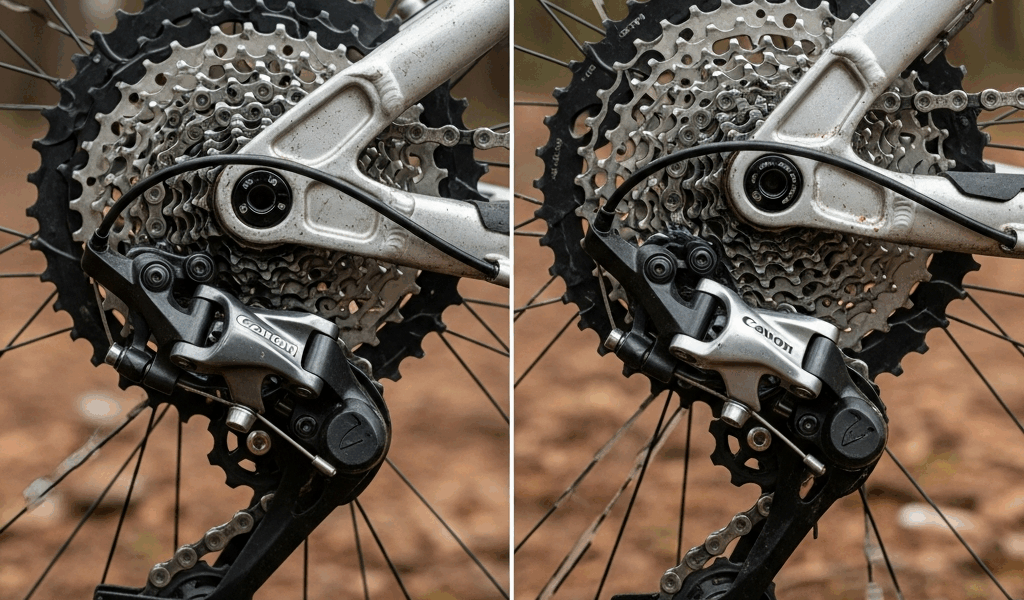
Shimano Deore 12-speed runs a 10-51t cassette. SRAM SX Eagle runs 11-50t. Those numbers look almost identical until you’re halfway up a loose, punchy climb and you’ve already run out of gears.
Shimano’s range clocks in at roughly 510 percent. SRAM SX lands around 454 percent. That 56-point gap lives almost entirely in the low end — Shimano’s 10t small cog versus SRAM’s 11t. On flat terrain, you’ll genuinely never notice. On a steep, sustained climb where you’re already grinding your smallest chainring, that extra bailout gear on Shimano is real. I’ve used it. Multiple times. Usually while making undignified noises.
What the Numbers Mean on Actual Trails
Running a 30t or 32t chainring up front, the Shimano 51t gives you a gear ratio around 0.59:1 or 0.63:1 depending on your chainring choice. That’s genuine bailout territory — the kind of gear that lets you spin up something you’d otherwise have to walk. SRAM’s 50t gets close but not quite there. For most trail riding it’s fine, honestly. For mountain climbers or anyone tackling technical singletrack with serious elevation gain, the Shimano range advantage is meaningful in a way you’ll actually feel.
Weight — Does It Actually Matter Here
Shimano Deore 12-speed cassette, the CS-M6100, weighs around 465g. SRAM SX Eagle cassette comes in at approximately 485g. The Shimano rear derailleur, the RD-M6100, sits around 290g versus SRAM SX Eagle’s roughly 310g. Shimano is lighter across the board — not dramatically, but consistently. Neither cassette wins any weight weenie awards. Both use full steel construction rather than the aluminum spider designs you see on higher-tier options. That’s what keeps them affordable.
Complete groupset pricing as of early 2025: Shimano Deore 12-speed — shifter, derailleur, cassette, chain — runs roughly $160–$185 USD depending on the retailer. SRAM SX Eagle equivalent lands around $140–$165. The gap is smaller than it used to be. It closes further once you factor in whether you need a new freehub body for either setup.
Shift Quality Under Load
Probably should have opened with this section, honestly, because for most riders this is the most noticeable day-to-day difference between these two drivetrains.
Shimano’s Hyperglide+ chain and cassette system is engineered specifically to shift under pedaling load. The cassette teeth have ramps and contours designed to catch and move the chain even when you’re pushing hard. On paper that sounds like marketing copy. On trail it’s actually real — I was skeptical too.
Why This Matters on Steep Climbs
Caught mid-climb on a loose, steep section with a gear that’s too hard, you have two options: soft-pedal momentarily to shift, or force the shift under load. With Shimano Hyperglide+, forcing the shift works. The chain moves. Not perfectly silky, but it catches and moves reliably. With SRAM SX Eagle, forcing a shift under heavy load produces that gritty, reluctant crunch that tells you the drivetrain isn’t ready. Not catastrophic. Just annoying — and occasionally costing you momentum at exactly the wrong moment.
SRAM’s higher-tier Eagle groups handle this better. GX, X01, XX1 all have SRAM’s own chain optimization dialed in. But SX is the budget entry point, and the chain and cassette at this price don’t have the same refinement. The shift quality gap between Shimano Deore and SRAM SX is actually larger than the gap between Shimano Deore and SRAM GX — worth knowing if you’re comparing across brands.
Shifting on Descents and Flat Ground
On descents and flat ground, both drivetrains perform well. Shifting down through the cassette under light load is smooth on both systems. Chain retention is solid on both — neither dropped a chain across several months of trail riding in mixed conditions. For casual trail riding, recreational use, or cross-country with manageable grades, the shift quality difference is noticeable but not dramatic. For technical climbing, it’s meaningful.
The shifter feel differs slightly too. Shimano’s SL-M6100 shifter has a positive, mechanical click — precise and satisfying. SRAM SX’s trigger shifter works fine but has a softer, slightly mushier feel. I’m apparently a tactile feedback person and Shimano works for me while SRAM SX never quite felt right. Most riders who’ve used both say the same thing, but personal preference is real here.
The Freehub Trap Nobody Explains Well
Here’s where I’ve watched a lot of people make expensive mistakes — including myself. Most articles mention freehub compatibility somewhere in a table near the bottom. That’s the wrong place for it. This is the decision that should come first. Don’t make my mistake.
Three Freehub Standards You Need to Know
But what is a freehub body, exactly? In essence, it’s the ratcheting mechanism on your rear hub that the cassette slides onto. But it’s much more than that — it’s the foundation your entire drivetrain decision is built on. There are three relevant standards in this conversation:
- Shimano HG (Hyperglide) — the standard that’s been around since the 1990s, used on virtually every Shimano drivetrain through 11-speed and some 12-speed builds
- Shimano Microspline — introduced for 12-speed, required for all Shimano 12-speed cassettes including Deore, SLX, XT, and XTR
- SRAM XD Driver — required for SRAM cassettes from GX Eagle upward
The SRAM SX Eagle cassette is specifically engineered to fit the old HG freehub body. Smart design for the budget market. If your bike is a few years old with a standard rear hub, there’s a very good chance it has an HG freehub, and SRAM SX will bolt right on. No hub swap, no additional freehub body, no surprise costs.
The Upgrade Path Problem
Here’s where the trap closes. You install SRAM SX Eagle because it fits your HG freehub. Good choice for now. Later you decide to upgrade to SRAM GX Eagle for better shift quality. GX Eagle requires an XD Driver freehub body. So you buy a new freehub body or swap the hub. Now you’re on XD Driver.
Next year you want to try Shimano XT because a friend swears by it. Shimano XT 12-speed requires Microspline. Your XD Driver doesn’t accept it. So you swap freehub bodies again — or you’re stuck. That’s two freehub swaps and a mild identity crisis for your rear wheel.
Compare that to starting on the Shimano path. You swap your HG freehub to Microspline once — many hubs support this swap for around $30–$50 for the freehub body itself. You install Shimano Deore. Every Shimano 12-speed cassette from Deore M6100 through XTR M9100 fits that same Microspline body. Deore to SLX to XT to XTR — one hub body change, then a clean runway for as long as you want to stay in the Shimano ecosystem. That’s what makes this upgrade path endearing to us incrementally-upgrading riders.
What Your Bike Probably Has Right Now
Bikes shipped with 11-speed or lower drivetrains almost certainly have HG freehub bodies. Bikes that came stock with 12-speed Shimano have Microspline. Bikes with SRAM GX Eagle or higher from the factory have XD Driver. Bikes that came stock with SRAM SX Eagle may have HG — that’s actually a common OEM choice precisely because SX fits HG and keeps build costs down.
To check: count the splines on your freehub body. HG has a distinctive notched pattern that looks like gear teeth. Microspline has smaller, more numerous engagement points arranged differently. XD Driver is a smooth-bodied driver with an external thread. Not sure? Pull up your hub’s spec sheet or ask at your local shop — they can identify it in about ten seconds flat.
Freehub body swaps are straightforward on quality hubs. DT Swiss, Industry Nine, Chris King, and most mid-range hubs from brands like Novatec all support swappable freehub bodies. Entry-level hubs on budget bikes sometimes don’t. Check before you buy anything.
The Cost of Getting This Wrong
A Shimano Microspline freehub body for a compatible hub runs $25–$55 depending on the hub brand. Minor cost if you’re planning for it. Annoying surprise if you bought the cassette first. I ordered a Shimano SLX cassette before confirming my freehub. That was late 2022. The cassette sat in a box on my workbench for six weeks until I sorted out the freehub situation. Entirely avoidable. Don’t make my mistake.
The Verdict
Shimano Deore wins for most riders upgrading an existing bike. It’s not a particularly close call.
Better shift quality under load, wider gear range with that 10-51t spread, slightly lighter components across the board, and a genuinely clean upgrade path within the Shimano 12-speed ecosystem. If you upgrade incrementally — buy Deore now, move to XT in two years — Shimano is built for exactly that approach. One Microspline freehub swap and you’re set for years of component upgrades without touching the hub again.
When SRAM SX Eagle Is the Right Answer
SRAM SX Eagle wins one specific scenario, and it wins it cleanly: you have an HG freehub body right now, you cannot or don’t want to swap it, and you need 12-speed performance at the lowest possible entry cost. In that situation, SX Eagle is a genuinely good product for the money. It works. Shift quality is adequate. The 11-50t range handles most riding without complaint. For casual trail riders, recreational cyclists, or anyone on a strict budget, there’s no shame in running SX Eagle — at least if you’re not planning to upgrade further up the SRAM stack later.
Where SX Eagle becomes the wrong choice is when riders install it thinking they’ll upgrade to GX or X01 down the road, not realizing that upgrade requires a completely different freehub body. That’s where the HG compatibility advantage quietly turns into a dead end.
The Summary You Can Screenshot
- Shimano Deore 12-speed — better shift quality under load, wider range (10-51t), clean upgrade path, requires Microspline freehub (~$30–$55 swap), complete groupset ~$160–$185
- SRAM SX Eagle — fits HG freehub with no swap needed, slightly lower entry cost, adequate shift quality, 11-50t range, complete groupset ~$140–$165
- Best for most upgrading riders — Shimano Deore, with a one-time Microspline freehub swap
- Best for HG freehub, no swap, lowest cost now — SRAM SX Eagle
Check your freehub body before ordering anything. That single step saves more frustration than any amount of comparison reading. Once you know what you’re working with, this decision gets significantly easier — and based on most riders’ situations, Shimano Deore is probably the one you’re looking for.



Stay in the loop
Get the latest trail rise updates delivered to your inbox.