Hiking Poles — Do You Actually Need Them and How to Use Them Right
Do you need hiking poles? Short answer: sometimes. That is genuinely the most honest thing I can tell you, and I know it is not the answer most gear articles lead with. I have hiked with poles, without poles, lost a pole down a ravine in the Cascades, and once carried two poles for eight miles on a flat rail trail while feeling quietly ridiculous. The question deserves a real answer, not a sales pitch dressed up as editorial content.
The Honest Answer — It Depends on the Terrain and You
Most articles about hiking poles say yes immediately. That is because most of those articles exist to sell poles, either through affiliate links or because they are written by gear brands. I am not saying poles are bad — I own two pairs — but the blanket recommendation frustrates me every time I see it.
Here is the actual breakdown.
Flat day hikes on maintained trails? You probably do not need them. A five-mile loop through a state park with a light daypack is not a situation that demands trekking pole support. Plenty of experienced hikers, people who have logged thousands of trail miles, make the deliberate choice to leave poles at home for easy terrain. That is not a beginner mistake. That is good judgment about what equipment the day actually calls for.
Steep descents when your knees are a known issue? Absolutely bring them. No question. Studies have measured up to 25 percent reduction in compressive knee force on downhill sections when poles are used correctly. That is not a marginal number. For anyone with existing knee problems, that difference is felt within the first mile of descent.
Long-distance backpacking with a loaded pack — say, anything over 35 pounds — poles shift a meaningful percentage of that load onto your arms and shoulders. On a three-day trip, that redistribution adds up to real fatigue savings in your legs. Your pace stays more consistent on day two and day three.
So the terrain and your physical situation matter more than any universal rule. Read that sentence again before you buy anything.
When Poles Make the Biggest Difference
There are specific conditions where I genuinely reach for poles without hesitation. These are not edge cases. They come up on regular hiking trips.
Steep Downhill Sections
This is where poles earn their keep more than anywhere else. The mechanics are simple — planting a pole ahead of you on a descent slows your momentum and distributes impact. Your quads take less of a beating. Your knees are protected from that repetitive loading that turns a six-mile hike into a three-day recovery situation. If your hike involves significant elevation loss, especially the back half of a summit route, poles are worth the weight.
Stream Crossings
Humbled by a knee-deep crossing on the Enchantments Trail in Washington, I started keeping poles extended even on sections where I thought I did not need them. Moving water reads depth wrong. Rocks are slippery in ways you cannot anticipate. Having two extra points of contact during a crossing is not overcaution — it is the difference between wet boots and a soaked pack.
Snow and Ice
Early season or high-elevation routes with snowpack are genuinely dangerous without some form of stability support. Poles give you that. They are not a substitute for crampons on technical terrain, but on packed snow traverses or icy morning trail sections, a planted pole can stop a slide before it starts.
Heavy Pack Situations
A loaded backpacking pack changes your center of gravity. On technical footing — talus fields, root networks, uneven rock — that shift matters. Poles extend your proprioceptive reach, which is a fancy way of saying your body knows where it is in space more accurately. Balance improves. Ankle rolls happen less.
When You Can Skip Them
Probably should have opened with this section, honestly. Because for a lot of hikers reading this, poles are genuinely optional.
Short hikes on well-maintained trails do not require poles. If the trail is marked, graded, and free of significant obstacles, your two legs are doing just fine on their own. The human body navigated trails without carbon fiber stick assistance for a very long time.
- Day hikes under eight miles with minimal elevation change
- Trails with paved or gravel sections
- Hikes where you are carrying under 20 pounds
- Routes you know well with no technical sections
- Situations where your hands need to be free — scrambling, photography, leashing a dog on tight switchbacks
Strong knees and good balance also change the calculus. A 28-year-old with no joint history and solid trail experience is not the same hiker as a 55-year-old recovering from a meniscus repair. Gear recommendations that ignore this difference are not useful recommendations.
I have watched experienced thru-hikers on the Pacific Crest Trail make deliberate decisions to carry no poles for entire sections because the weight and management hassle outweighed the benefit on that particular stretch. These are not people who do not know better. They are people who know exactly what they are doing.
How to Use Poles Properly — Most People Get This Wrong
Here is where I need to be direct: I used poles incorrectly for the first two years I owned them. I had no idea. My wrists ached after long days and I thought it was just part of the deal.
It was not. I was using the straps wrong.
Strap Usage
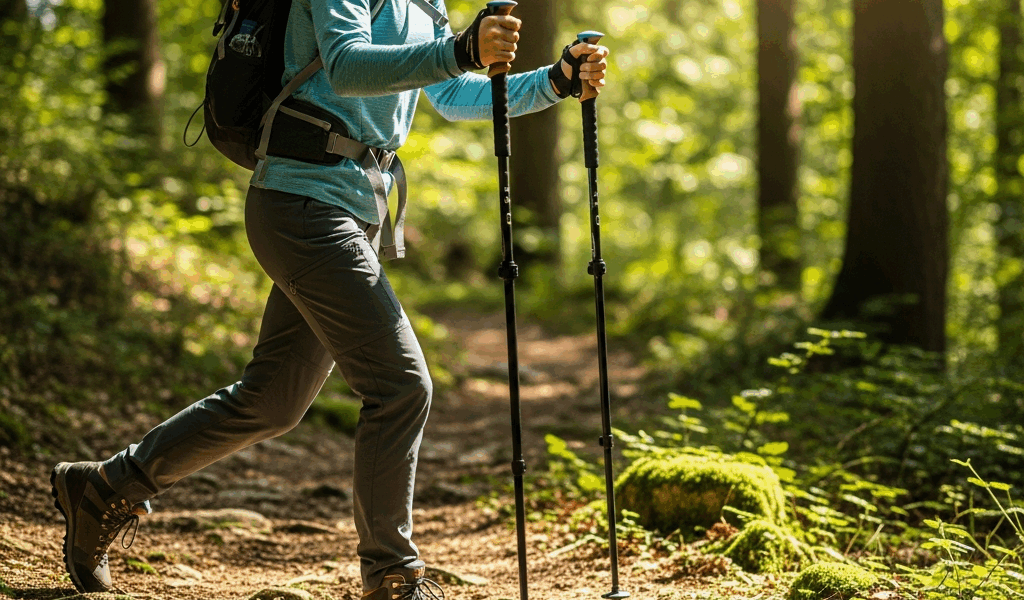
The single most common mistake. Most people thread their hand through the strap from above, like grabbing a bag handle. Wrong. Thread your hand up through the strap from below, so the strap runs across your palm and between your thumb and forefinger. Then grip the handle lightly — the strap should support the pole on the plant phase, not your grip strength. Your hand should be relaxed. This one change eliminated my wrist soreness completely within a single hike.
Height Adjustment
For flat terrain, adjust so your elbow is at roughly 90 degrees when the pole tip is planted on the ground next to your foot. On steep uphills, shorten the poles by about 5 to 10 centimeters. On steep downhills, lengthen them by the same. Most people set their poles once at the trailhead and never touch them again. Adjust for terrain.
Pole Plant Timing
Plant the right pole with the left foot. Plant the left pole with the right foot. This is the natural cross-body pattern that matches your walking gait and keeps your stride balanced. When people plant same-side pole and foot, they disrupt their natural movement pattern and the poles stop doing useful work. They just become expensive walking decorations.
On Descents Specifically
Plant both poles slightly ahead of your body before stepping down. Let the poles absorb the initial load. Do not plant behind you on a descent — that actually increases knee stress rather than reducing it, which defeats the whole purpose.
Buying Considerations If You Decide Yes
This is not a full gear review. But if you have worked through the above and decided poles make sense for your hiking, here is what actually matters at the purchase decision.
Carbon vs Aluminum
Carbon poles are lighter — a pair like the Black Diamond Distance Carbon Z comes in around 9.2 ounces per pair. Aluminum poles, like the REI Co-op Passage or Black Diamond Trail, weigh closer to 18 to 20 ounces per pair but cost significantly less and survive abuse better. Carbon snaps under lateral stress. Aluminum bends. If you are a weekend hiker and not a gram-counter, aluminum is the rational choice. Serious long-distance backpackers often pay the weight penalty premium.
Folding vs Telescoping
Folding poles pack down smaller — useful for stuffing into a pack on sections where you are not using them. They are generally faster to deploy. Telescoping poles offer more granular length adjustment, which matters if you need to fine-tune for different terrain constantly. For most hikers, either works. Folding mechanisms add a small failure point over time.
Cork vs Foam Grips
Cork grips — found on poles like the Leki Micro Vario Cork — absorb moisture and conform to your hand shape over time. Foam grips are lighter and warmer to the touch in cold weather but wear down faster. Rubber grips are durable but can cause hand fatigue on long days. Cork is the classic choice for good reason.
Budget entry point for a functional aluminum pair runs about $40 to $60. Mid-range carbon options start around $120. You do not need to spend more than $150 to get a pole that will perform well across years of regular hiking use.
Buy based on what your hiking actually looks like — not what looks impressive in a gear photo.



Stay in the loop
Get the latest trail rise updates delivered to your inbox.